
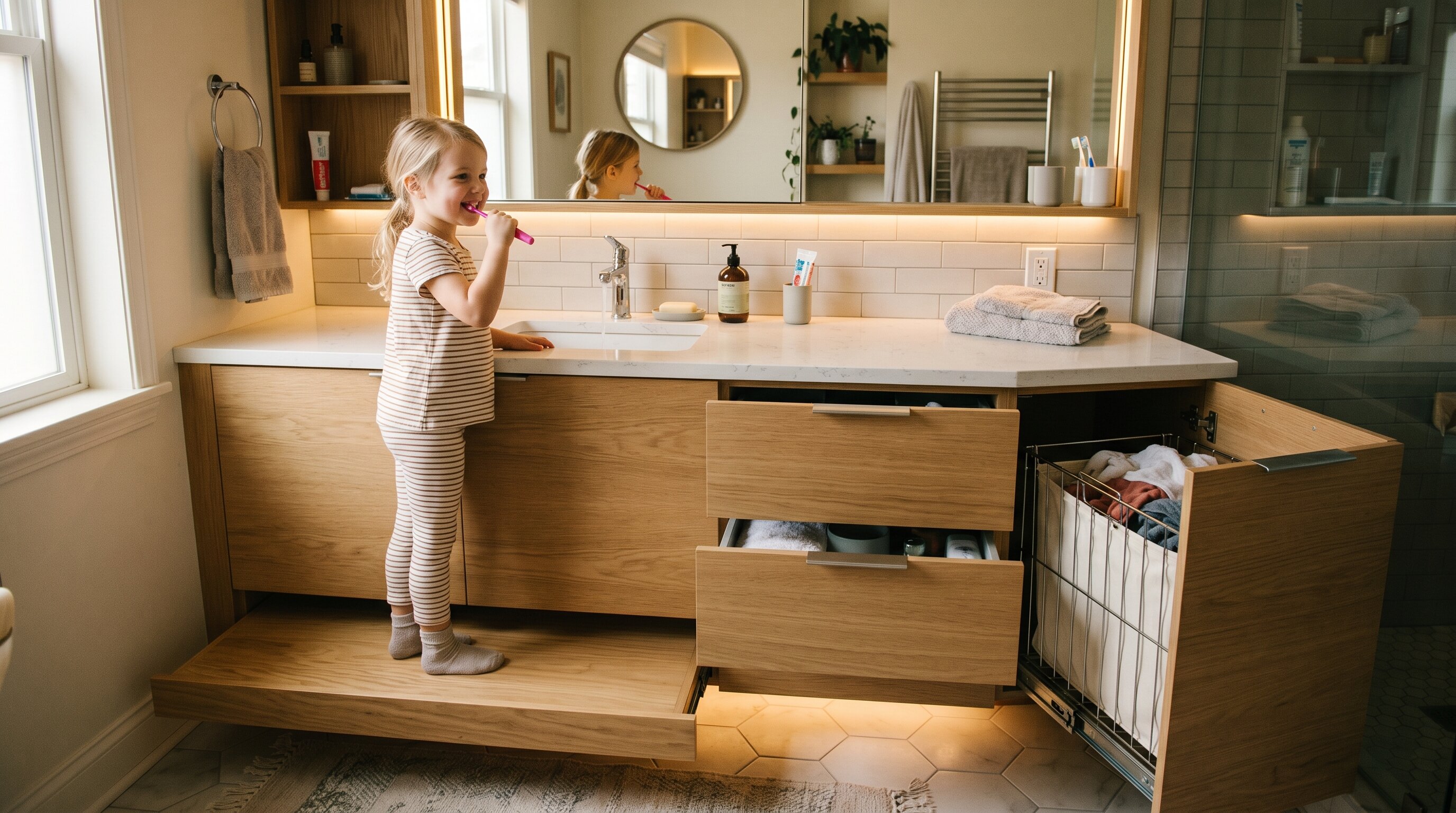
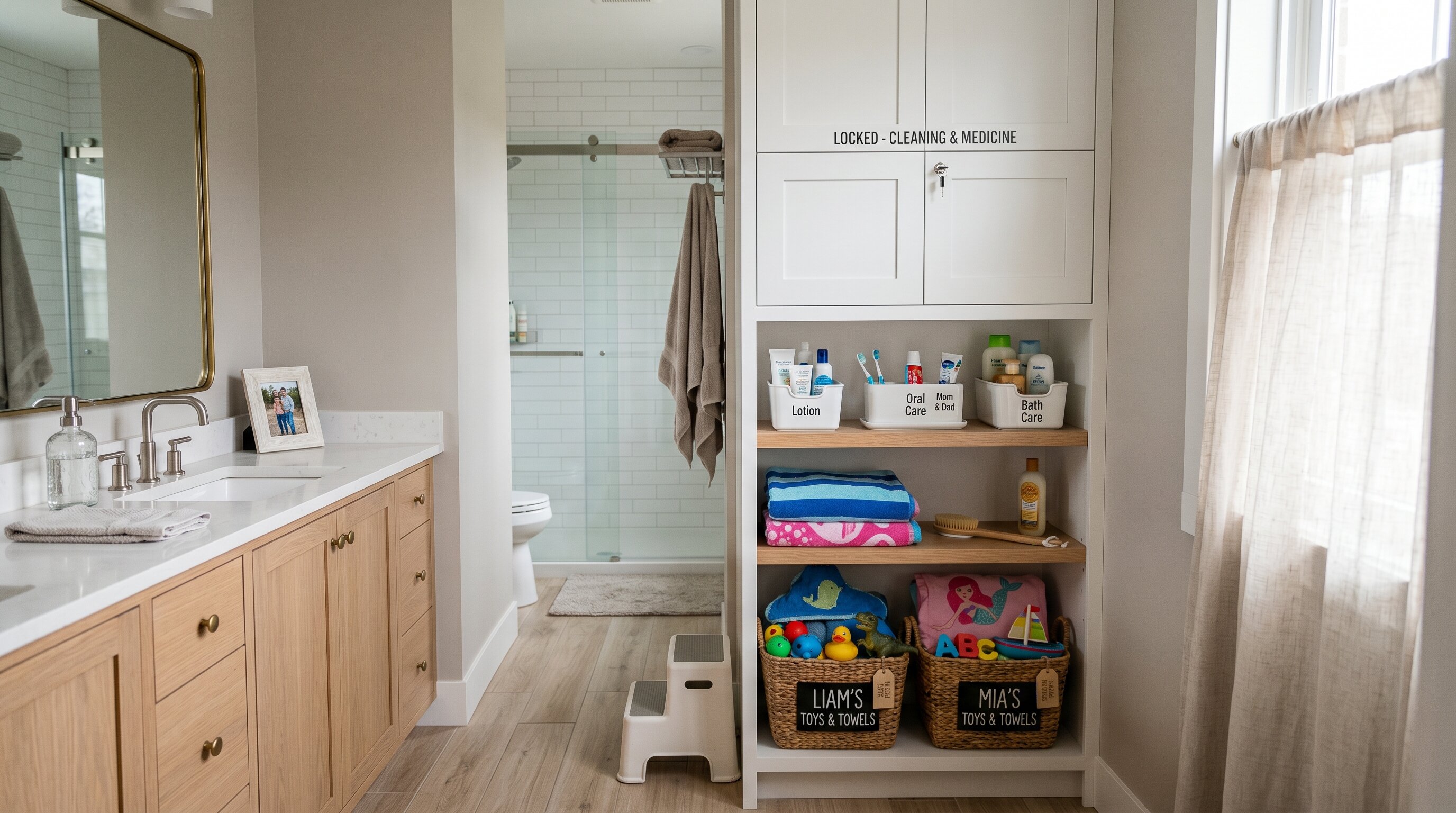
It's 7:45am. Two kids need the sink. You need the sink. Nobody can find the toothpaste.Not a bad morning. Every morning. A bathroom that wasn't built for a family doesn't quietly inconvenience you it grinds you down before you've had coffee. The fix isn't a bigger room. It's a room that was actually thought through. The family friendly bathroom design ideas worth stealing aren't the ones that photograph well. They're the ones that still work when your toddler is a teenager who needs three minutes alone with a mirror. Design it now for who they'll be, not who they are. Bathroom falls are the leading cause of home injury in children under five. Most renovations treat flooring as an aesthetic question and stop there. That's backwards. Not all non-slip tiles perform the same which most people discover when someone slips. R10 is the minimum you want for any wet-area floor. Below that, you're taking a risk that doesn't need to be taken. Material costs only; 2026 industry averages. Installation adds $3–$10/sq ft depending on subfloor and region. A thermostatic shower valve pre-sets a maximum water temperature. One fitting, done once, and the scalding risk is gone. If you're renovating and skip this, you'll spend the next several years managing the tap by hand every bath time. It's a small thing to specify at the start and a genuinely annoying problem to live with if you don't. Soft-close drawers sound like a minor detail. They're not minor if your four-year-old gets a finger caught in a cabinet every other week. Grab bars get avoided because they read as medical equipment. They're not, they're a safety feature that works for supervising baths when children are small and for general stability when they're not. Install them at 33–36 inches from the floor, ANSI A117.1 standard, minimum 250 lb capacity. No one notices them. Everyone uses them. Bathroom clutter with kids isn't a tidiness failure. It's what happens when there's no real structure to the storage. More baskets don't fix a structural problem. A floor-to-ceiling tower cabinet does two jobs at once. Kids' items towels, bath toys, and shampoo sit in the lower half where small hands can reach them. Medicines and cleaning supplies go in the upper half, locked. This is the one storage decision in a child bathroom that also functions as a safety decision. Worth building around. Each child gets one labelled bin and responsibility for what's in it. Sounds obvious. Consistently not done. The bathrooms that stay manageable are the ones where ownership is clear. A recessed shower niche 3.5 inches deep, fitted between wall studs means no product bottles cluttering the edge of the bath, no falling shampoo at 6am. A recessed medicine cabinet above the vanity is the same idea applied differently: flush to the wall, out of reach, completely invisible when closed. These two together are what make a bathroom feel genuinely finished rather than just clean. A pull-out step built into the vanity base disappears when it's not needed. The alternative is a free-standing stool getting kicked around the floor most of the day. One is a design solution. The other is a compromise that becomes furniture. Built-in laundry hamper, divided into two sections one for towels, one for clothes. Most families add this after six months of stepping over things. Better to just build it in. Wall-mount the toilet brush. It clears floor space and keeps it at a height that makes sense for adults rather than a height that makes sense for a toddler who shouldn't be near it. 3. Layout and Zoning: Ending the Morning Rush for Good Family bathroom layout isn't really about square footage. It's about whether two people can use the room at the same time. Most bathrooms are designed as if only one person exists. A Jack and Jill bathroom sits between two bedrooms, each with its own door into the shared space. It's genuinely one of the most practical layouts for families with children in adjacent rooms, and it's underused. The version worth building has three zones: a central double vanity accessible from both bedrooms, a pocket-door toilet room off to one side, and a pocket-door shower room on the other. One child can shower while another uses the toilet and a third is at the sink. The morning argument ends. Double vanities run 60–72 inches wide. Where space is tight, a trough sink, one basin, two faucets, less cabinet depth does the same job in a smaller footprint. Dual-flush toilet for the shared zone: 0.8 gallons for a partial flush, 1.6 for a full one. A full Jack and Jill remodel runs $15,000–$40,000 depending on scope and location (per America's Advantage Remodeling) substantially, but it's essentially two bathrooms from one set of plumbing. Pocket doors make it possible. They recover 5–6 sq ft compared to hinged doors. In a shared bathroom, that's a vanity drawer or a laundry hamper recovered from nowhere. A 5×8 ft bathroom can fit a double vanity. Tight, yes but whether tight feels cramped depends entirely on which layout you're working with. Four options consistently work well in smaller spaces. Bath with shower over it: most space-efficient, leaves room for a proper vanity unit. Separate bath and shower: more dedicated zones, slightly tighter around the toilet. Bath under the window: natural light makes the room read larger than it is. Focal-point bath with walk-in shower: the statement version of a room that feels considered rather than squeezed. A floating vanity with under-cabinet LED strips opens any of these layouts up visually. The floor reads as bigger than it is and the thing is easier to clean, which matters when four people are using it every day. If the bathroom is at its limit, a half-bath somewhere else toilet and small vanity, under stairs or in a large closet takes real pressure off the main room. It doesn't transform anything, but it means one fewer person waiting. The straightforward version: a family bathroom shouldn't look like a children's theme park and it shouldn't look like a showroom. It should look like a room that a real family uses comfortably, not chaotic, and capable of changing as the children do. A neutral base porcelain or quartz, soft white, warm grey, natural sand holds up for ten years without looking tired. That layer is permanent. Personality sits on top: removable wallpaper, coloured towels, a shower curtain, hooks that might have a sea creature on them for a few years. Removable wallpaper lasts five to seven years and peels off without damage. It's the honest answer to the question of how to give a bathroom some character without committing to it forever. When your kids decide they're too old for whatever theme is currently on the walls, you peel it off. No remodel required. It also sidesteps the gender question: a neutral base with swappable accessories works for any combination of children, any age, without designing specifically for any of them. Towel hooks, mirrors, plants, and finishing touches Three rows of hooks: 18–24 inches for toddlers, 28–32 for school-age, 48 for adults. All three, installed now. The bottom rows become guest towel hooks eventually. Nothing is wasted. Bold tile on the floor, not the walls. Wall tile is what you see every day; floor tile is what you walk on. Bold walls are fun in a showroom photo and exhausting to live with once the children change their minds about dolphins. A lower mirror or one large adjustable one lets smaller children see themselves at the sink. This sounds minor and makes mornings noticeably easier. A trailing plant on the wall adds something to a modern family bathroom without using floor space, which in most family bathrooms is either already spoken for or actively contested. The most common family bathroom mistake is designing for the children you have right now. Toddlers become school-age kids. School-age kids become teenagers who want privacy and somewhere to put their things. A bathroom that fits perfectly at age four feels wrong at age twelve, and a remodel at age twelve was never in the plan. Permanent fixtures belong to the oldest version of your family. Accessories belong to the youngest. The zero-threshold shower is the fixture most people don't prioritise when children are small, and most people wish they'd specified when they're older. It works for bathing a toddler with a handheld showerhead today. In ten years it's just a shower that anyone in the house can use easily, including guests. Specifying it at build costs nothing extra. Retrofitting it later costs real money. Choose permanent things for who your family will be. Let the rest be easy to change. That's the whole logic of child-friendly bathroom design and the reason the families who do it this way tend not to remodel twice. Zone it first two or three people using it at once is the problem to solve, and layout is the lever. Then: R10 flooring, thermostatic shower valve, soft-close drawers, pull-out step at the vanity, four-part storage system. Choose the permanent fixtures for the teenagers your children will become. Let the accessories handle who they are right now. Porcelain tile if durability is the priority water absorption below 0.5%, R10+ rated, $3–$10/sq ft for materials. Vinyl if softness matters it reaches R10–R12 and is easier on small children, at $2–$7/sq ft. Either works well. Smooth glazed tile is the one to avoid regardless of how it looks in the showroom. Build a system rather than accumulating storage. Floor-to-ceiling tower cabinet: kids' items in the lower half, anything hazardous locked in the upper half. One labelled bin per child. Recessed shower niche for daily-use products. Recessed medicine cabinet above the vanity for anything that shouldn't be at floor level. Separate storage for each person beats shared storage that nobody maintains. A shared bathroom with a door from each of two separate bedrooms not a hallway, two bedrooms. The most functional version has a central double vanity and separate pocket-door rooms for the toilet and shower. Three people can use different parts of it at once. That's the appeal. R10-rated flooring plus anti-slip mats inside the tub and outside the shower. The thermostatic shower valve set it once, scalding risk gone. Soft-close drawers throughout. Childproof locks on anything at floor level. Pull-out step at the vanity. Rounded edges on the vanity or corner guards on whatever's already there. None of this is expensive relative to a remodel, and all of it makes a real difference. A kids bathroom is built around children it needs to change as they do. A family bathroom is built around a household of mixed ages using the same room. The fixtures, storage, and layout serve everyone from toddler to adult without modification. It's more considered to design and doesn't need to be redone. Start with the safety layer. Build the storage system properly rather than accumulating things that don't work together. Get the layout right before you worry about anything else. Everything visible can follow, and most of it can be updated as your children grow out of whatever phase they're currently in. The bathroom that still works when the youngest leaves for university looks a lot like the one described here. Design it once. Mean it.1. Safety First Designing a Bathroom Kids Can't Hurt Themselves In
Choose the right flooring: understanding slip resistance ratings
Temperature, impact, and touch: the other safety essentials
2. Smart Storage: A System, Not a Collection of Bins
The four-part family bathroom storage system
Vanity storage: pull-out steps, soft-close drawers, and laundry
Jack and Jill bathroom layout: the three-zone solution
Small family bathroom ideas: four layouts that work
4. Style and Decor: Modern Family Bathroom Ideas That Age Well
The neutral base and swappable layer strategy
5. Designing for the Long Game: A Bathroom That Grows With Your Family
The three age stages: what stays permanent and what changes
Frequently Asked Questions
How do you design a family bathroom?
What is the best flooring for a family bathroom?
How do you organise a shared kids bathroom?
What is a Jack and Jill bathroom?
How do you make a bathroom safe for toddlers?
What is the difference between a family bathroom and a kids bathroom?
Conclusion
Modern Family Bathroom Ideas: Build One Bathroom That Works for Every Age
Family friendly bathroom design ideas built for every age R10 flooring specs, Jack and Jill layouts, a smart storage system,decor that adapts as your kids grow.

Written by Zohaib Ali
More on Nationwide BuildersRead more Home Improvement Tips blogs

Top services
Homeowners
Support