
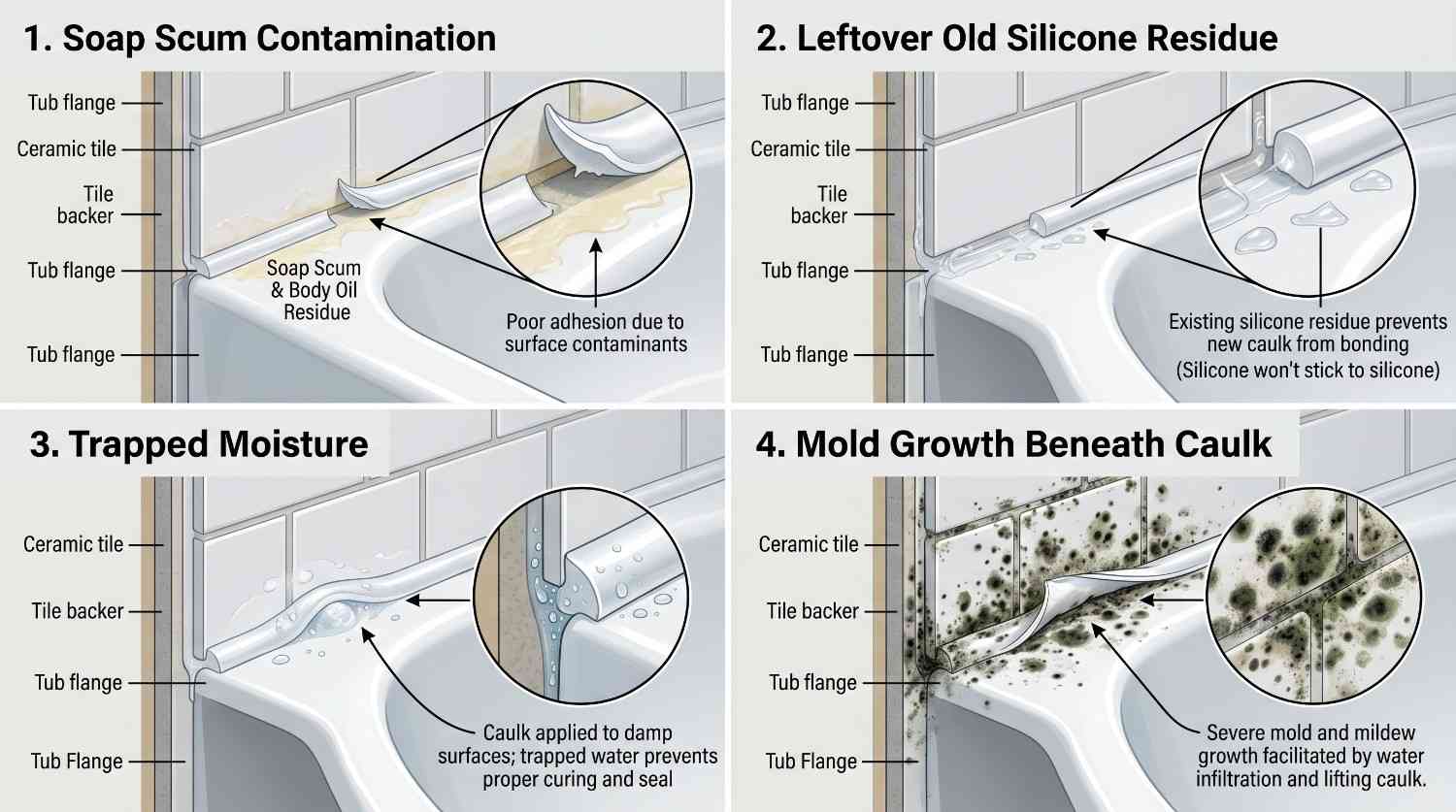
Caulk peeling around a bathtub within weeks or months of application is almost never a product defect; it is a surface preparation failure. Caulk cannot bond to soap scum, residual old caulk, moisture, or mildew-stained substrate, regardless of brand or price. The caulk didn't fail. The surface under it did. A secondary cause is the wrong caulk type: latex-based caulk used in a wet bathtub environment dissolves progressively with every shower. Quality silicone caulk for a bathtub correctly applied over a clean, dry, old-caulk-free surface lasts 5–10 years. Caulk applied over an unprepared surface fails in under six months sometimes weeks.
Mold established in bathroom joints within 24–48 hours of sustained moisture accelerates this failure. Once mold colonizes beneath the bead, the bond between caulk and substrate degrades continuously, and no amount of re-application fixes it without full removal and remediation first.
What Causes Bathtub Caulk to Peel Off So Quickly?
Surface Contamination at Application
Poor surface preparation is responsible for the majority of premature bathtub caulk peeling cases. The three most damaging contaminants are soap scum, residual silicone from old caulk, and surface moisture. Soap scum, a calcium stearate film left by hard water reacting with bar soap, creates a release layer between the caulk bead and the tub surface. Caulk applied over it adheres to the soap scum film, not the tub itself, and peels as a strip within weeks. Soap scum preventing adhesion is the single most underestimated cause of repeated caulk failure.
Residual silicone from a previous bead compounds the problem. Silicone does not bond to itself reliably when the old layer is aged or contaminated. Applying caulk over old caulk even a thin remnant guarantees the new bead fails at the interface of the two layers rather than bonding to the tub.
Wrong Caulk Type for a Wet Environment
Latex vs silicone caulk is not a cosmetic choice in a bathtub application it is a durability decision. Latex-based (acrylic) caulk is water-soluble: repeated submersion and steam exposure cause it to swell, soften, and lose adhesion over months. Silicone caulk for a bathtub is waterproof, flexible, and mold-resistant by composition. In a daily-use bathtub environment, latex caulk is the wrong material regardless of preparation quality. The correct specification is 100% silicone or a siliconized acrylic hybrid rated for wet-area immersion.
Insufficient Cure Time Before Water Exposure
Caulk cure time is the most commonly skipped step in DIY re-caulking. Standard silicone caulk skins over in 30–60 minutes but requires a full 24 hours to cure for light water contact and 48–72 hours to reach full waterproof strength. Exposing fresh caulk to shower water or tub use before full cure prevents the cross-linking that creates the waterproof seal. The result is a bead that looks complete but never achieved adhesion and peels within the first few uses. Fast-cure silicone products reduce this to 3–6 hours minimum, but full cure still requires 24 hours before full water immersion.
Bathtub Movement Under Load
A bathtub separating from the wall at the caulk joint visible as a gap that opens when weight is applied indicates the tub itself is flexing. Fiberglass and acrylic tubs deflect under the weight of water and a person. Standard caulk without adequate elasticity cracks or peels at the joint as the tub cycles between loaded and unloaded states.
The correct fix: fill the tub with water before applying the caulk bead so the joint is set at maximum load deflection. When the tub empties, the caulk compresses slightly rather than stretching to failure. This single step extends caulk life significantly in flexible tub installations.
How to Recaulk a Bathtub So It Lasts
Follow this sequence precisely skipping any step replicates the same failure:
Remove all old caulk : use a caulk remover tool or utility knife; zero residue tolerance
Clean with isopropyl alcohol : removes soap scum, mildew residue, and silicone film; let dry fully
Treat visible mold : scrub with a 1:3 bleach-water solution; rinse and allow 24 hours to dry completely
Fill the tub with water : stand in it to load the joint at maximum deflection before applying
Apply 100% silicone or mildew-resistant caulk : smooth with a wet finger in a single continuous pass
Do not use the tub for 24–48 hours : full cure before any water contact
Inspect annually : at first sign of cracking, gap, or discoloration, remove and re-apply before water infiltrates
Do not apply caulk over old caulk under any circumstances. The new bead bonds to the contaminated surface of the old layer, not the tub and the failure timeline resets back to weeks, not years.
If bathroom caulk keeps cracking in the same location after correct preparation, the joint is under structural movement: a fiberglass tub flexing on an uneven support, or wall tile shifting. A bathroom contractor can assess whether the tub requires re-setting or additional substrate support before the caulk joint will hold long-term. Nationwide Builders connects homeowners with vetted local contractors who assess the substrate before quoting recaulk work preventing the cycle of repeated failed DIY applications.
Frequently Asked Questions
Why does my bathtub caulk keep peeling off even when I use a good brand?
Brand quality is irrelevant when the surface is contaminated. Bathtub caulk peeling off from a premium silicone product within weeks almost always means soap scum, residual old caulk, or surface moisture was present at application. Silicone bonds to clean, dry substrate not to calcium stearate film or aged silicone. Strip the joint completely, clean with isopropyl alcohol, allow full drying, and reapply. The brand rarely needs changing; the preparation process does.
How long does caulk last around a bathtub?
How long caulk lasts depends on three factors: material type, surface preparation, and bathroom ventilation. Quality 100% silicone applied over a correctly prepared surface lasts 5–10 years. Latex or acrylic caulk in a wet-immersion environment lasts 1–3 years regardless of preparation. Poor preparation cuts any caulk's lifespan to under six months. Annual inspection catches early failure before water infiltrates behind the tub and begins damaging the subfloor or wall framing.
Should I use silicone or latex caulk around my bathtub?
Always use 100% silicone or a siliconized acrylic hybrid rated for wet-area immersion. Latex vs silicone caulk in a bathtub context: latex is paintable and easier to tool, but water-soluble it degrades under repeated shower and bath exposure. Silicone is waterproof, flexible, and chemically resistant to soap and cleaning products. The only scenario where latex is appropriate is in a low-moisture area where the surface will be painted over. For any joint that contacts standing or running water, silicone is the correct material.
Can I caulk over the old peeling caulk to stop the peeling?
No. Caulk over old caulk bonds to the deteriorated surface of the existing bead not to the tub or tile underneath. The failure point moves to the interface between old and new caulk, and the new bead peels in the same pattern as the old one, often faster. Complete removal of all existing caulk is a non-negotiable step before re-application. Caulk remover gel ($6–$12) softens old beads for clean extraction. The 30 minutes this step takes determines whether the new job lasts 5 years or 5 months.