
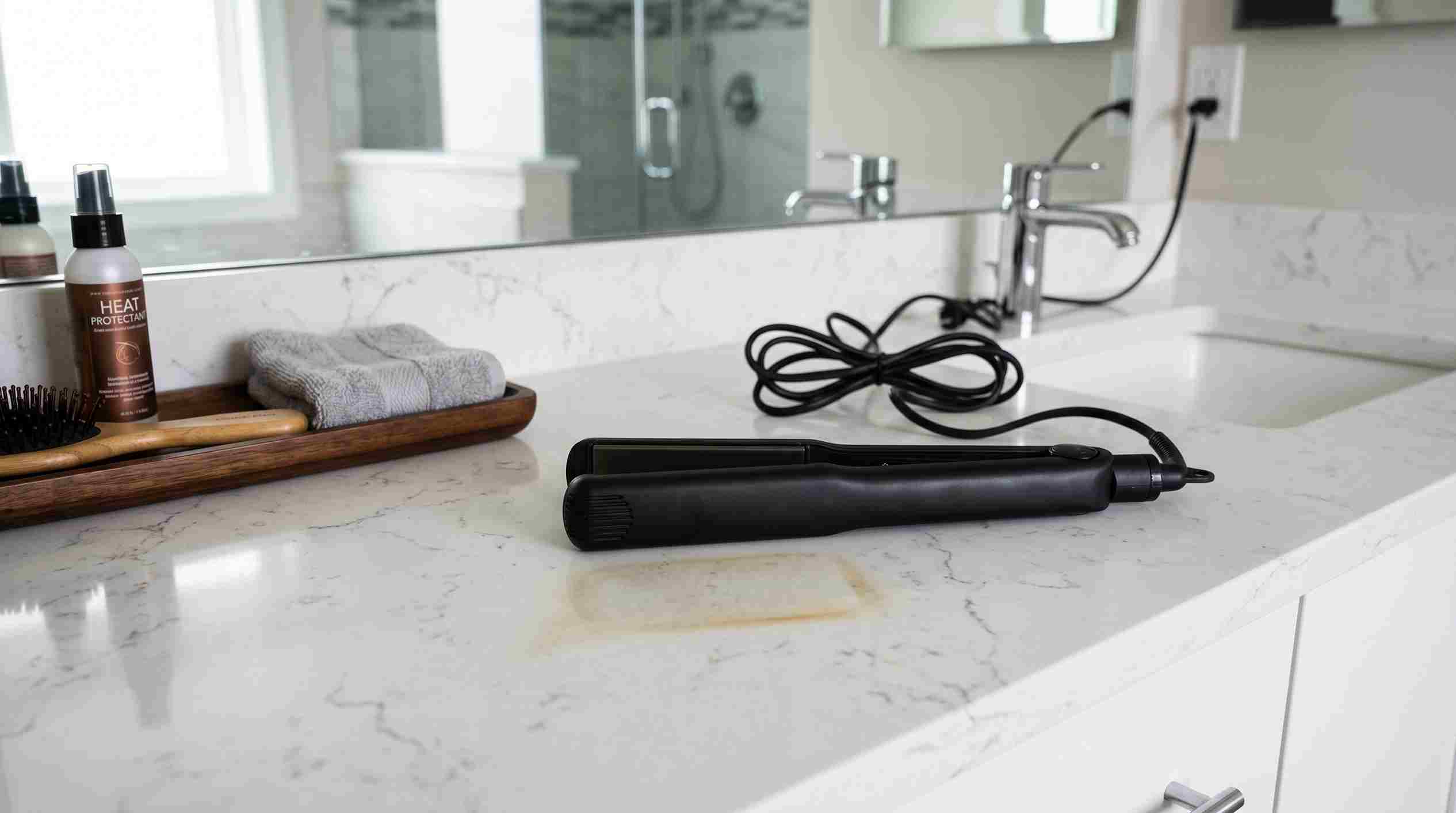
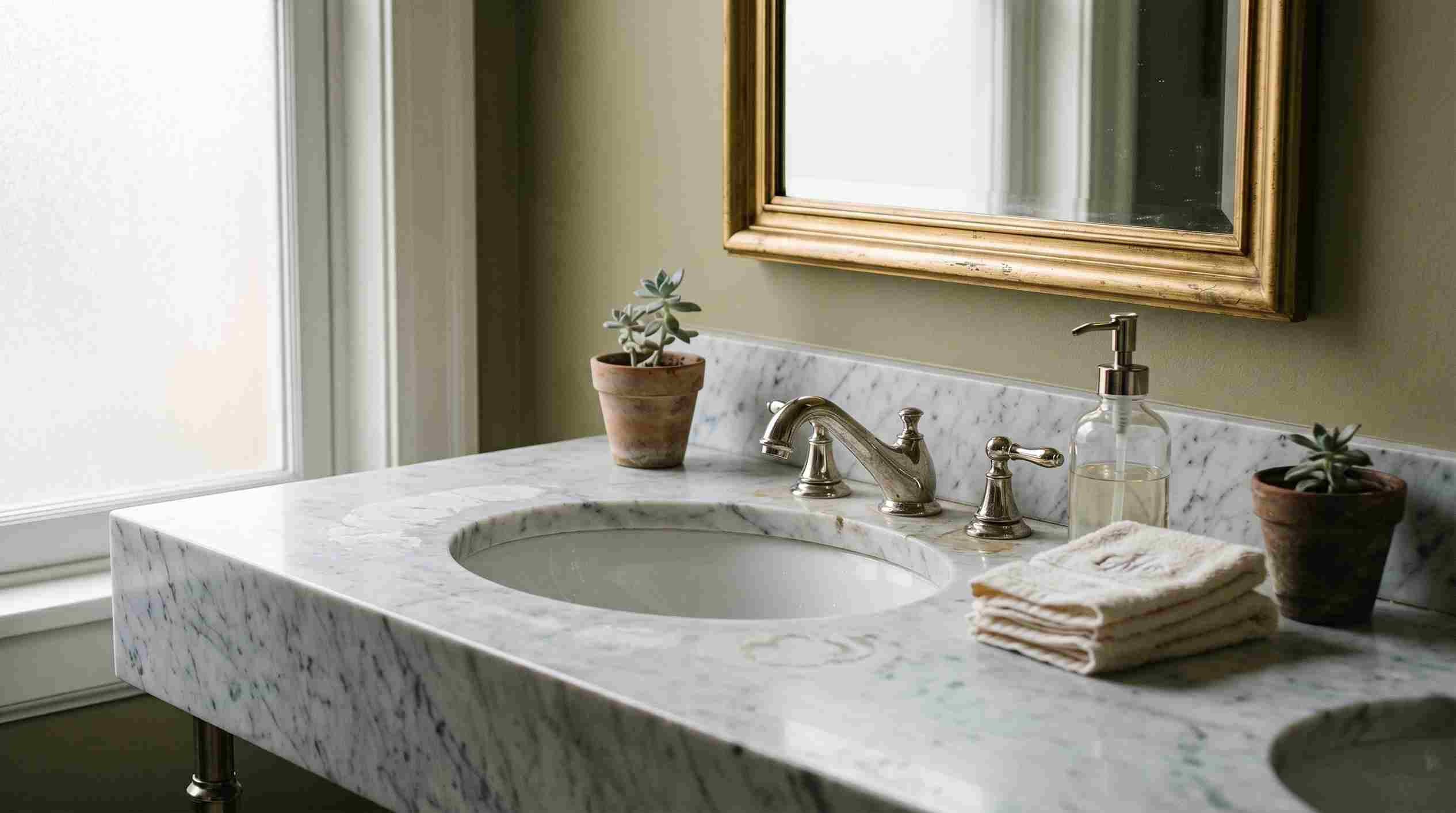
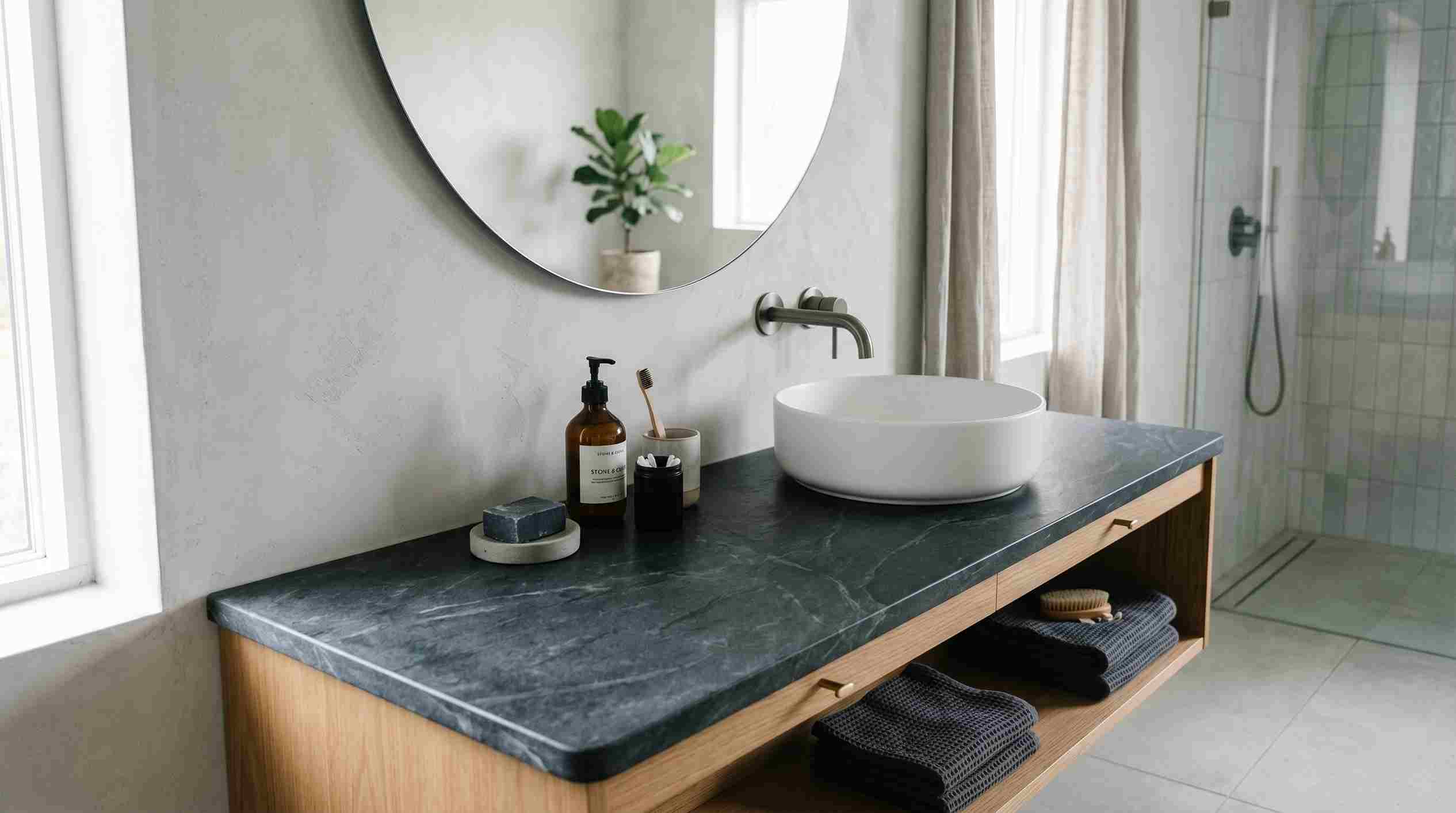
The countertop is the most-touched surface in your bathroom and the first thing anyone notices. Getting the material right means understanding three things: how the surface handles daily humidity, what maintenance it actually requires, and one thing most guides miss is whether it can survive a set-down hair straightener. The average bathroom vanity is around 6 square feet. That matters because a material priced at $150 per square foot sounds alarming until you realise the total project cost is around $900. The scale changes the economics completely. Quartz contains resin sustained heat from styling tools that damages the surface. See below. Before comparing individual materials, this is the most important decision in bathroom countertop selection: Non-porous (quartz, porcelain, laminate, solid surface, cultured marble, soapstone) resist moisture, stains, and bacteria without sealing. In a bathroom where humidity is constant and spilled products are routine this means no ongoing maintenance commitment. Porous materials (granite, marble, quartzite, concrete) absorb moisture and stain unless sealed regularly. In a bathroom, that sealing cycle is non-negotiable, not optional. Skip it and the stone discolours, absorbs hair product residue, and becomes a mould breeding ground at the sink edge. Neither group is wrong. But knowing which side your chosen material sits on tells you exactly what you're committing to for the life of the countertop. Quartz is engineered from ground natural quartz and resin typically 90–94% stone, the rest polymer. The resin is what makes it non-porous and stain-resistant, and the same resin is its only real limitation in a bathroom context. The heat tool warning no competitor mentions: quartz is not fully heat-resistant. While it handles brief contact fine, sustained heat from a flat iron or curling wand resting on the surface can permanently discolour or crack the resin. If your bathroom sees daily styling tool use, quartz is still an excellent choice but use a heat mat. Granite or porcelain are safer if tools routinely sit on the counter. For everything else, quartz is hard to beat: no sealing, no staining, easy to clean, and available in marble-look patterns that are visually indistinguishable from the real thing at a fraction of the maintenance. Cost: $75–$200+/sq ft Granite Granite is porous it must be sealed every 12–18 months. That is one afternoon of work per year and a $15–$40 can of sealer. If that commitment is acceptable, granite delivers things quartz cannot: true heat resistance that makes it the right choice for styling-heavy bathrooms, a unique natural slab pattern, and a lifespan measured in decades. High-quality granite lasts 50+ years. The sealing frequency is the honest conversation competitors avoid. Miss a year and a spilled toner or leave-in treatment can leave a permanent stain on light-coloured granite. Cost: $70–$175+/sq ft Marble is the most beautiful and the highest-maintenance bathroom countertop material. It is porous, prone to etching from acidic products (most haircare products qualify), and stains more readily than granite even with regular sealing. Marble is best reserved for powder rooms spaces with low daily traffic and controlled use. In a busy family bathroom, marble will require constant attention to look its best. Homeowners who love the look but not the maintenance should consider a marble-pattern quartz instead. Cost: $75–$200+/sq ft Porcelain is the underrated choice in bathroom countertops. It is non-porous, requires no sealing, is fully heat-resistant, and resists scratches and chemicals. Large-format porcelain slabs create a seamless, minimal aesthetic that suits contemporary bathrooms especially well. At $25–$75 per square foot, it is also the most affordable non-porous hard-surface option which at 6 square feet means a total material cost of $150–$450 before installation. The limitation is fabrication: porcelain slab requires professional cutting and installation. It cannot be DIYed. Cost: $25–$75/sq ft Solid surface is the only bathroom countertop material that can be repaired. Scratches and minor damage can be buffed out with fine sandpaper a repair option no other material on this list offers. Its second major advantage: integrated sink options. Solid surface can be moulded into a one-piece countertop-and-sink unit with no seam between surface and basin. No seam means no place for moisture and bacteria to accumulate. In a bathroom, that seam between a drop-in sink and countertop is where mold lives. A seamless unit eliminates this entirely. Non-porous and mid-priced, solid surface is the practical family bathroom choice that rarely gets the attention it deserves. Cost: $50–$120/sq ft Cultured marble is made from marble dust and resin affordable, non-porous, and available as a one-piece integrated countertop and sink unit. The same no-seam advantage as solid surface applies here. The trade-off: cultured marble scratches over time, especially with abrasive cleaners. It cannot be repaired the way a solid surface can. But for a guest bathroom or a budget-conscious primary bath, it delivers the marble aesthetic with none of the sealing commitment and a practical seamless sink option. Cost: $40–$100/sq ft Laminate is the entry-level option and an honest one. It is non-porous, easy to clean, available in hundreds of patterns, and genuinely DIY-friendly. It is also the one material on this list that cannot handle heat. A hair straightener or curling iron left on laminate will burn and warp it permanently. If styling tools never touch your countertop, laminate is a practical and cost-effective choice. If they do, it is not. Cost: $20–$60/sq ft Soapstone is the natural stone option for homeowners who want the real-stone aesthetic without the sealing commitment. It is non-porous, heat-resistant, and develops a natural patina over time. It requires only occasional oiling if you want to manage the darkening process. The colour range is limited so soapstone is typically dark grey to black which makes it a specific stylistic choice rather than a universal recommendation. Cost: $70–$100/sq ft Work through these questions in order: 1. Do you use hot styling tools directly on the counter? Yes → eliminate laminate (burns) and use quartz only with a heat mat. Best choices: granite, porcelain. No → all materials remain in play. 2. How much maintenance are you willing to do? None → choose from: quartz, porcelain, solid surface, cultured marble, laminate, soapstone. Annual sealing is acceptable → granite or quartzite are available options. Never → eliminate marble (requires frequent sealing and immediate spill attention). 3. Do you want an integrated sink? Yes → cultured marble or solid surface. No seam = no mould accumulation point. No → any material works; undermount sinks give the cleanest look with solid countertops. 4. What is your realistic budget? Under $500 total project → laminate or cultured marble. $500–$1,500 → porcelain slab, solid surface. $1,500–$3,000 → quartz, granite. $3,000+ → marble, quartzite, bookmatched natural stone. (Based on avg 6 sq ft vanity + professional installation) Quartz is the most recommended material for busy bathrooms, non-porous, no sealing, stain-resistant, and durable. But if you regularly rest hot styling tools on the counter, granite or porcelain is a safer choice because quartz resin can be damaged by sustained heat. Quartz, porcelain slab, solid surface, cultured marble, laminate, and soapstone all require no sealing. Granite, marble, quartzite, and concrete are porous and require regular sealing to prevent staining and moisture damage. Often yes. The average bathroom vanity is about 6 square feet. At that size, upgrading from $40/sq ft laminate to $100/sq ft quartz costs roughly $360 more in material, a small difference in the context of a bathroom remodel budget, and the difference in durability and longevity is significant. Cultured marble and solid surface both offer one-piece countertop-and-sink units. The seamless design eliminates the joint between sink and countertop, the most common point for mold and bacterial build-up in bathroom basins. Marble is beautiful but high-maintenance. It is porous, etches with acidic cleaners and most haircare products, and requires frequent sealing. It works well in powder rooms or guest baths with low daily traffic. For a busy primary bathroom, marble-look quartz delivers the aesthetic without the maintenance burden.Bathroom Countertop Materials Cost Comparison
The Non-Porous vs Porous Split
Non-porous materials
Porous materials
Bathroom Countertop Types
Quartz
Marble
Porcelain Slab
Solid Surface (Corian and similar)
Cultured Marble
 Laminate
Soapstone
 How to Choose Your Bathroom Countertop
Frequently Asked Questions
What is the best bathroom countertop material?
Which bathroom countertop options require no sealing?
Are expensive countertop materials worth it in a small bathroom?
What bathroom countertop works best with an integrated sink?
Is marble a good choice for a bathroom countertop?
Bathroom Countertop: Materials, Costs & How to Choose
Bathroom countertop materials compared: cost table, sealing reality, the quartz heat warning, and a 4-step decision guide to find your best match.

Written by Zohaib Ali
More on Nationwide BuildersRead more Home Improvement Tips blogs
Pros
Support