
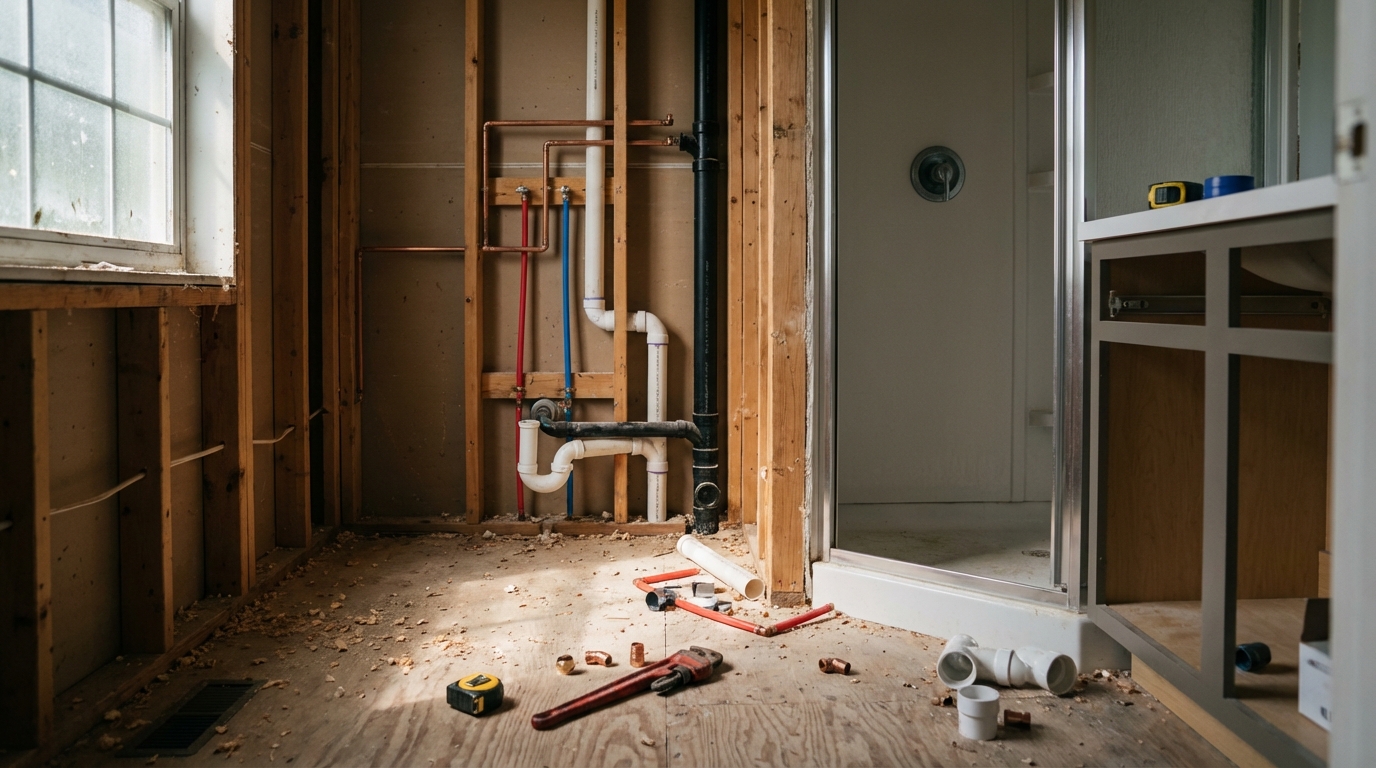

The bathroom plumbing cost is one of the most variable line items in any renovation or new construction project. A standard rough-in for a three-fixture bath in new construction costs dramatically less than rerouting drain lines in a finished basement or moving a toilet across a wet wall. Both are “bathroom plumbing projects” the price difference reflects the scope, not the skill of the contractor.
This guide covers every scenario: cost to install plumbing for a new bathroom, rough-in costs by fixture, cost to move plumbing in a bathroom, basement bathroom plumbing, remodel plumbing costs, and a fixture-by-fixture breakdown with real project examples.
Average Bathroom Plumbing Cost
The national average cost to plumb a bathroom depends almost entirely on what the word ‘plumbing’ means in context. For a new bathroom being added to an existing home, the plumbing cost alone averages $3,000 to $6,000. For a bathroom remodel where the layout stays the same, plumbing work averages $800 to $2,500. For a full gut renovation with drain relocation, expect $2,500 to $5,000 for plumbing alone.
Licensed plumbers charge $75 to $150 per hour, with most bathroom plumbing projects requiring 10 to 40 hours of total labor depending on scope. Materials pipe, fittings, valves, and drain assemblies typically represent 25 to 40 percent of the total plumbing budget on standard projects.
Cost to Install Plumbing for a New Bathroom
The cost to install plumbing for a new bathroom in an existing home ranges from $1,500 to $6,000 for a standard three-fixture bathroom. This covers running supply lines (hot and cold water), installing the drain and vent stack connections, and roughing in the connection points for a toilet, sink, and shower or tub. Finish plumbing setting the actual fixtures adds another $600 to $1,800.
The primary cost variable for new bathroom plumbing is distance from the existing plumbing stack. A bathroom directly above or adjacent to the main stack costs significantly less than one on the opposite side of the home, where supply and drain pipes must travel 20 to 40 feet.
Key Insight: The single most expensive decision in new bathroom plumbing is whether the project requires a new vent stack. Adding a secondary vent stack adds $1,500 to $3,500 because it requires cutting through framing and roofing to reach the exterior.
Bathroom Remodel Plumbing Costs
The plumbing cost for a bathroom remodel depends on whether the existing layout is retained or changed. Keeping the toilet, sink, and shower in the same positions means minimal plumbing costs supply lines and drain connections can be reused with only minor updates.
Remodel Without Plumbing Relocation: $800 to $2,500
When a remodel retains the existing plumbing layout, the plumber’s scope includes replacing shut-off valves and supply lines, connecting new fixtures to existing drain stubs, updating the shower valve and cartridge, and inspecting drain and vent connections. Total plumbing labor runs 8 to 18 hours at $75 to $150 per hour, plus $200 to $600 in materials.
Remodel With Partial Plumbing Relocation: $1,500 to $4,000
Moving a single fixture to a nearby location shifting the toilet a few feet or repositioning the sink within the same wet wall requires opening the floor or wall to extend drain and supply lines. Each fixture relocation adds $500 to $1,500 in plumbing cost depending on the distance from the existing connection point.
Cost to Move Bathroom Plumbing
The cost to move plumbing in a bathroom is $500 to $3,500 per fixture depending on the distance of the move, the floor/wall construction, and whether drain lines must be rerouted beneath a concrete slab. Moving plumbing is consistently the most underestimated line item in bathroom remodels. Drain lines must maintain a continuous slope of ¼ inch per foot to drain properly, which often requires opening significantly more floor area than expected.
Critical Warning: Moving bathroom plumbing through a concrete slab is the most expensive relocation scenario in the US. Cutting concrete, rerouting drain lines below grade, and repatching adds $1,000 to $2,500 beyond the standard cost of the same move in a wood-frame floor. Always confirm with your plumber whether your bathroom sits over a concrete slab before budgeting a layout change.
Bathroom Rough-In Plumbing Cost
Rough-in plumbing refers to all the work done behind walls and under floors before any fixture is installed: running supply pipes, installing drain pipes with the correct slope, tying into the vent stack, and stubbing out connection points at each fixture location. Rough-in plumbing typically represents 60 to 70 percent of the total plumbing budget in new construction.
For basement bathroom rough-in, add $500 to $2,000 for below-grade drain work. New construction rough-in costs less per fixture than renovation rough-in because walls and floors are open, making access significantly faster.
Basement Bathroom Plumbing Cost
The cost to plumb a basement bathroom is $2,000 to $5,500, higher than a standard above-grade bathroom of the same size. The premium comes entirely from drainage. Gravity-fed drain lines in a basement must either connect to a main stack that is lower than the basement floor (uncommon in most US homes) or use a sewage ejector pump system to move waste upward to the main drain.
Cost to Finish a Basement Bathroom with Rough-In Plumbing
Many homes have pre-installed rough-in plumbing stubs in the basement drain and supply line stub-outs left during original construction for a future bathroom. Finishing a basement bathroom that already has rough-in plumbing costs $800 to $2,000 for plumbing alone. The plumber’s scope is limited to setting the fixtures, connecting to the stubs, and testing. This is one of the most cost-efficient bathroom additions available.
Builder Tip: Before planning a basement bathroom, locate your floor drain stub-outs. If rough-in stubs exist, the plumbing cost drops by 50 to 70 percent. Check the basement floor near the center of the home typically near the water heater or utility area.
Bathroom Plumbing Cost by Fixture
Understanding plumbing costs by individual fixture is the most accurate way to build a project budget when adding or replacing specific items.
Plumber Cost to Replace a Bathroom Faucet
The plumber cost to replace a bathroom faucet is $100 to $350 total, including parts and labor. A standard faucet replacement takes 30 to 60 minutes for an experienced plumber at $75 to $150 per hour, plus $40 to $200 for the faucet depending on grade. Homeowner-supplied faucets can reduce the total cost by $30 to $80 compared to contractor-sourced hardware.
Plumbing Cost by Number of Bathrooms
The cost to plumb a multi-bathroom house scales with the number of bathrooms, but not linearly. Each additional bathroom added to a new home costs less per unit than the first because the main supply runs and vent stack are already in place.
Small Bathroom Plumbing Cost
The plumbing cost for a small bathroom is often disproportionately high relative to the space because the same minimum trade charges, permit fees, and supply run costs apply regardless of square footage. A small powder room or half bath has two fixtures (toilet and sink) instead of three, which reduces material cost but not labor minimums.
For a small three-fixture master bath (40 to 60 sq ft), standard plumbing installation costs $1,200 to $3,500. For a half bath with two fixtures, plumbing costs $800 to $2,500. The per-square-foot plumbing cost in small bathrooms is often $50 to $80 higher than in larger primary baths.
Labor Cost Breakdown for Bathroom Plumbing
Labor is the dominant cost in bathroom plumbing, typically representing 60 to 75 percent of total project cost. Understanding how plumbers charge helps in evaluating quotes accurately.
Most plumbers charge a minimum service call fee of $75 to $150 that applies regardless of how little time the job takes. For small jobs like a single faucet replacement, the minimum service charge often represents the majority of the invoice.
Hidden and Additional Costs
Contractor quotes for bathroom plumbing frequently exclude several line items that are either assumed, dependent on site conditions, or only discovered after work begins.
How to Get Accurate Bathroom Plumbing Quotes
Getting three written, itemized quotes from licensed plumbers is the most reliable way to avoid the two most common mistakes homeowners make: accepting a single-line estimate that hides scope assumptions, and choosing the lowest bid without verifying what is and is not included.
Always hire a licensed plumber.
In most US states, bathroom rough-in and fixture work requires a licensed journeyman or master plumber. Unlicensed work creates permit and insurance problems.Request itemized quotes.
A quote listing only a total number cannot be meaningfully compared. Ask for fixture-by-fixture line items and a breakdown of rough-in versus finish work.Clarify what is excluded.
Permits, subfloor repairs, and wall patching are commonly excluded from baseline plumbing quotes and treated as change orders when discovered.Verify permit responsibility.
In most jurisdictions, the licensed plumber is responsible for pulling the plumbing permit. If a contractor says you must pull your own permit, that is a red flag.Check license and insurance.
Verify the plumber’s license number through your state licensing board and confirm they carry general liability and workers’ compensation insurance before signing.
Pro Tip:
For remodel projects, ask each bidding plumber to identify any conditions behind the walls or under the floor that could affect price before they submit their quote. A plumber who walks the space thoroughly and asks about the home’s age and pipe material is a better long-term choice than one who quotes based on square footage alone.
Key Takeaways
The average bathroom plumbing cost is $1,500 to $6,000 for a new installation in a standard three-fixture bathroom (toilet, sink, shower). A basic remodel with no plumbing relocation runs $800 to $2,500. Moving or rerouting existing plumbing costs $500 to $3,500 depending on distance and fixture count. Adding a completely new bathroom to an existing home costs $3,000 to $8,000 for plumbing alone. Labor accounts for 60 to 75 percent of total bathroom plumbing cost in most projects.
Frequently Asked Questions
How much does bathroom plumbing cost?
The average bathroom plumbing cost is $1,500 to $6,000 for a new three-fixture installation. A remodel with no plumbing changes costs $800 to $2,500. Moving plumbing costs $500 to $3,500 per fixture. The total depends primarily on whether the project involves new rough-in work, relocation of existing drain lines, or finish plumbing only.
How much does it cost to plumb a bathroom?
The cost to plumb a bathroom from scratch in an existing home is $1,500 to $6,000 for a standard three-fixture bath. New construction rough-in costs $1,000 to $3,500 because walls are open. Finishing a basement with existing rough-in stubs is the lowest-cost scenario at $800 to $2,000 for plumbing alone.
How much does it cost to install bathroom plumbing?
The cost to install bathroom plumbing for a new bathroom addition is $3,000 to $8,000. This includes running supply lines, installing drain and vent connections, and completing finish plumbing for toilet, sink, and shower. Distance from the existing main stack is the largest cost variable.
How much does it cost to move bathroom plumbing?
The cost to move bathroom plumbing is $500 to $1,500 per fixture for small relocations in wood-frame floors. Moving drain lines in a concrete slab adds $1,500 to $3,500 per fixture due to saw-cutting, rerouting, and concrete patching. Moving a toilet is typically the most expensive single-fixture relocation because of drain slope requirements.
How much does it cost to move plumbing in a bathroom?
The cost to move plumbing in a bathroom ranges from $500 for a minor supply line extension to $5,000 or more for a complete layout reconfiguration involving drain relocation under a slab. Moving multiple fixtures simultaneously is more cost-efficient because mobilization and floor-opening costs are shared.
How much does it cost to plumb a basement bathroom?
The cost to plumb a basement bathroom is $2,000 to $5,500 without existing rough-in. If a sewage ejector pump is required, add $800 to $2,000. If rough-in stubs are already present, finish plumbing costs $800 to $2,000.
How much does plumbing cost for a bathroom remodel?
The plumbing cost for a bathroom remodel ranges from $800 to $2,500 when the existing layout is unchanged. If fixtures are being relocated, add $500 to $1,500 per fixture. A full gut renovation with new layout plumbing runs $3,500 to $7,000. Plumbing typically represents 12 to 18 percent of the total budget in a standard master bath remodel.
How much does it cost to replace bathroom plumbing?
The cost to replace bathroom plumbing supply and drain pipes themselves is $1,500 to $5,000 for a single bathroom. Replacing galvanized steel supply lines with copper or PEX costs $1,000 to $3,000. Replacing cast iron drain lines with ABS or PVC costs $800 to $2,500.
How much does a plumber charge to replace a bathroom faucet?
The plumber cost to replace a bathroom faucet is $100 to $350 total including parts and labor. Labor for a straightforward faucet swap runs $75 to $200 depending on access and the minimum service call charge in your area. Supplying the faucet yourself reduces total cost by $30 to $80.
How much does plumbing cost for a new bathroom?
The plumbing cost for a new bathroom in an existing home is $3,000 to $8,000 for a full three-fixture installation including rough-in and finish work. New construction costs $1,500 to $4,000. A half bath toilet and sink only is $1,500 to $3,500.
How much does plumbing cost for a small bathroom?
Plumbing cost for a small bathroom 40 to 60 sq ft is generally within 10 to 15 percent of a standard-sized bathroom because pipe runs, trade minimums, and permit costs are largely fixed regardless of square footage. Expect $1,200 to $3,500 for a small three-fixture bath and $800 to $2,500 for a small bath remodel with the layout unchanged.
How much does plumbing cost for a bathroom remodel as a share of total budget?
Plumbing is typically 12 to 18 percent of the total bathroom remodel budget. For a $20,000 standard remodel, expect $2,400 to $3,600 in plumbing costs. For a $45,000 gut renovation with new layout, plumbing costs $5,400 to $8,100. If the layout is unchanged, plumbing costs drop to $800 to $2,500 regardless of the total remodel budget.