
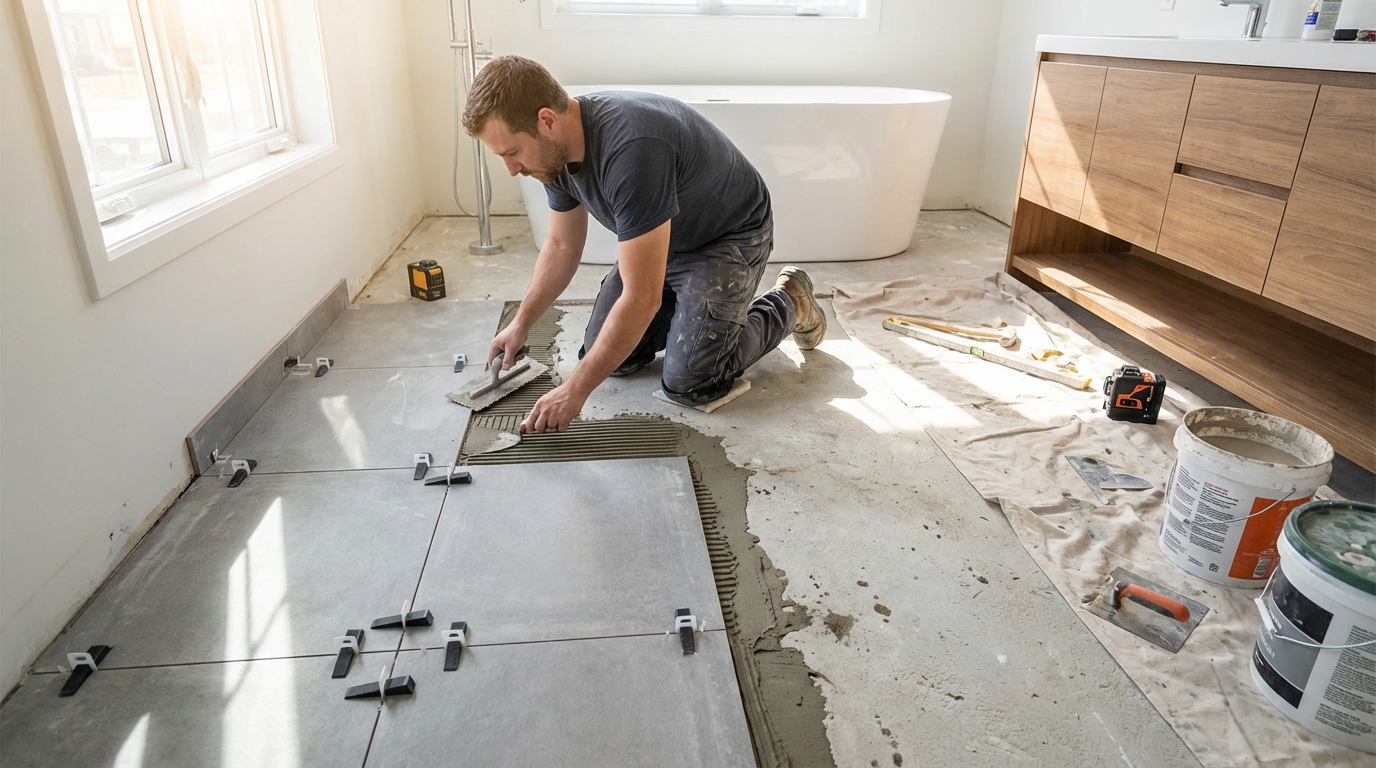

Planning a bathroom remodel starts with one unavoidable question: how much will the flooring set you back? Whether you are upgrading a powder room or overhauling a master bathroom, understanding the true cost of bathroom flooring installation helps you budget accurately, avoid surprises, and make smarter material choices.
In this guide, you will find current, data-backed cost ranges for every major bathroom flooring type, key cost factors contractors actually use to price jobs, and practical strategies to reduce your total spend without sacrificing quality.
Average Bathroom Flooring Installation Cost by Type
The table below covers the most common bathroom flooring materials and their installed price ranges per square foot in the United States.
Cost of Installing Tile Floor in Bathroom
Tile is the most popular bathroom flooring choice in the US and for good reason. It is water-resistant, durable, easy to clean, and available in hundreds of styles. According to aggregated contractor data, the cost of installing tile floor in bathroom ranges from $5 to $15 per square foot installed.
Ceramic vs. Porcelain Tile: Cost Breakdown
Ceramic tile is the more affordable option, with materials typically running $1–$5 per square foot. Porcelain is denser, more water-resistant, and longer-lasting, but costs more usually $3–$10 per square foot for materials alone.
The cost to install floor tile in bathroom also depends heavily on tile size and pattern complexity. Large-format tiles (24"x24" or bigger) require more precise subfloor leveling, which adds to labor costs. Herringbone or diagonal patterns increase labor time by 15–25%.
Bathroom Floor Tile Installation Cost per Square Foot
For a standard 5x8 bathroom (40 sq ft), expect to pay between $500 and $1,200 for ceramic tile installed. For a larger master bathroom remodel (80–120 sq ft), ceramic tile installation typically costs $1,500–$3,500, while porcelain tile can push $3,000–$6,000 depending on material selection and subfloor condition.
Heated Bathroom Floor Installation Cost
Radiant heated bathroom floors have surged in popularity, especially in master bathroom remodels. The heated bathroom floor installation cost depends on two main system types: electric (mat-based) and hydronic (water-based).
Electric radiant systems are far more common in bathrooms due to lower installation complexity. The cost of installing a heated floor in a bathroom typically ranges from $8 to $16 per square foot installed, including the heating mat, thermostat, and labor.
Cost of Installing Heated Bathroom Floor: What's Included
A full heated floor installation includes the heating element (mat or cable), a programmable thermostat, and wiring to a dedicated circuit. Always verify whether your existing electrical panel can support the additional load a panel upgrade can add $500–$2,000 if required.
For a 50 sq ft master bathroom, the cost to install heated floor in bathroom runs approximately $400–$650 for the electric mat system, plus $200–$400 for an electrician, putting the total heated bathroom floor installation cost between $600 and $1,050 for that size room.
Vinyl & Laminate Bathroom Flooring Cost
Vinyl and laminate are the go-to budget-friendly options that still deliver a polished look. Luxury vinyl plank (LVP) has become especially popular in bathrooms because it is 100% waterproof, durable underfoot, and available in wood-look finishes.
The cost to install vinyl flooring in bathroom averages $3.50–$8 per square foot installed, while laminate runs $3.50–$9 per square foot. Note that standard laminate (not waterproof-rated) is generally not recommended for full bathrooms due to moisture sensitivity.
Key Factors That Drive Your Bathroom Flooring Installation Cost
No two bathrooms are priced identically. These are the primary variables contractors use to generate estimates:
Bathroom Size
This is the most obvious factor. Flooring is priced per square foot, so a larger bathroom always costs more. However, very small bathrooms (under 35 sq ft) sometimes carry a minimum job charge of $200–$400 from contractors, making the effective per-square-foot cost higher.
Subfloor Condition
A damaged, uneven, or structurally compromised subfloor must be repaired or replaced before new flooring goes down. Subfloor repair typically adds $1.50–$7.00 per square foot to the total project cost. This is one of the most common sources of budget overruns in bathroom remodels.
Material Selection
As detailed above, material choice dramatically affects cost. Ceramic tile is the most cost-effective durable option; natural stone (marble, travertine, slate) sits at the top of the price range. Always factor in the cost of grout, mortar, cement board, and underlayment these add $0.75–$2.50 per square foot.
Labor & Geographic Location
Labor rates vary significantly by region. Contractors in major metros like New York, San Francisco, and Los Angeles charge 30–60% more than the national average. Always get 3 quotes from local licensed contractors.
Tile Layout Complexity
A straight-lay grid pattern is the most economical to install. Diagonal patterns, herringbone, chevron, or custom mosaic designs require more cuts and significantly more time, adding $1–$5 per square foot to labor costs alone.
Old Flooring Removal
Demolition and disposal of existing flooring typically adds $1–$3 per square foot. Removing ceramic tile from a concrete subfloor is especially labor-intensive and may push removal costs higher.
Labor Cost to Install Bathroom Floor Tile
Labor is often the largest single line item in a bathroom flooring project. The labor cost to install bathroom floor tile in the US typically ranges from $4 to $10 per square foot, depending on tile type, pattern, and regional labor rates.
For context, a standard bathroom tile installation (40 sq ft, straight lay, ceramic) takes a professional tile setter approximately 4–8 hours, including prep, setting, grouting, and cleanup. At typical contractor rates of $50–$100/hour, labor alone comes to $200–$800 for that size bathroom.
Bathroom Flooring Cost by Bathroom Size
The table below provides realistic total installed cost estimates (materials + labor) for
common bathroom sizes and the most popular flooring types.
DIY vs. Professional Installation
DIY tile installation can save $200–$800 in labor on a standard bathroom, but it carries real risks. Improperly set tile leads to cracking, grout failure, and moisture infiltration into the subfloor all of which cost significantly more to fix than the original labor savings.
Heated floor mat installation is one area where a confident DIYer can safely handle the flooring portion, though the electrical connections should always be made by a licensed electrician.
LVP (luxury vinyl plank) floating floors are the most DIY-friendly option no adhesive, no grout, and installation requires only basic tools. A motivated homeowner can typically install LVP in a bathroom in 2–4 hours.
How to Lower Your Bathroom Flooring Installation Cost
Smart planning and a few strategic choices can meaningfully reduce your total bathroom flooring cost:
• Get at least 3 quotes from licensed local contractors and compare itemized line items, not just the total.
• Choose 12x12 or 13x13 ceramic tiles in a straight-lay grid, the lowest-cost tile installation scenario.
• Purchase materials yourself from a tile distributor or big-box retailer and hire labor separately this can save 15–30% on material markups.
• Schedule your project during off-peak season (winter months in most regions) when contractor demand is lower and pricing is more negotiable.
• Address subfloor issues before getting contractor quotes knowing the subfloor condition prevents nasty mid-project surprises.
• For heated floors, choosing an electric mat system over hydronic installation is simpler, no boiler integration needed, and the upfront cost is dramatically lower.
• Reuse the existing subfloor if it is in good condition this eliminates a significant cost item.
Frequently Asked Questions
How much does bathroom floor installation cost on average?
The national average bathroom floor installation cost is approximately $800–$1,500 for a standard 50 sq ft bathroom, including both materials and professional labor, using ceramic or porcelain tile.
What is the cheapest bathroom flooring to install?
Luxury vinyl plank (LVP) and sheet vinyl are the most affordable installed options, typically running $3–$8 per square foot complete. They are also 100% waterproof, making them a smart value choice for bathrooms.
How much does it cost to install heated bathroom floors?
The cost to install heated bathroom floors with an electric radiant mat system typically ranges from $550 to $1,050 for a 50 sq ft bathroom, including the heating element, thermostat, and licensed electrician fees.
How much does tile installation labor cost per square foot?
The labor cost to install bathroom floor tile averages $4–$10 per square foot in the US. Simple straight-lay patterns fall at the lower end; complex patterns (herringbone, diagonal, mosaic) fall at the higher end.
How much does it cost to install a bathroom floor myself?
DIY ceramic tile installation in a bathroom costs $150–$500 in materials for a 40–50 sq ft bathroom (tile, cement board, mortar, grout, tools). LVP installation is even lower, starting around $100–$300 in materials for the same size space.
Does bathroom flooring installation include removal of old flooring?
Not always this must be confirmed with your contractor. Old floor removal typically adds $1–$3 per square foot to the total project cost and should be itemized separately in any quote you receive.
Final Thoughts
Bathroom flooring installation cost is not a one-size-fits-all number. A basic vinyl floor in a half-bath might cost $300 total. A full master bathroom remodel with heated porcelain tile could easily reach $5,000–$8,000 once you factor in subfloor work, electrical, and premium materials.
The most important variables are: bathroom size, flooring material, subfloor condition, and local labor rates. Get multiple itemized quotes, choose materials that match your long-term goals, and budget a 10–15% contingency for unexpected subfloor or structural issues.
With the right planning, your bathroom flooring project can deliver lasting value especially as part of a broader master bathroom remodel that commands a strong return at resale.