
Heated Bathroom Floor Cost in 2026: Full Breakdown by System, Size and Install Type$700 - $6,000
Average fixed price
Heated Bathroom Floor Cost in 2026: Full Breakdown by System, Size and Install Type

Heated bathroom floors are one of the most consistently requested bathroom upgrades in the United States, and the cost is significantly lower than most homeowners expect. An electric in-floor heating system for a standard 60-square-foot master bath costs less than a new toilet and faucet combination, yet the comfort impact is immediate and daily.
This guide covers every cost variable: electric mat versus cable systems, hydronic versus electric comparison, cost by bathroom size, operating costs per month, hidden line items, flooring compatibility, and three real-world installed examples at budget, mid-range, and high-end price points.
Average Heated Bathroom Floor Cost
The national average cost of a heated bathroom floor is $700 to $1,400 for a standard 50-square-foot bathroom with an electric radiant heating mat system, professionally installed with a programmable thermostat. Whether you search for heated floor cost bathroom, heated floor in bathroom cost, or heated floors in bathroom cost the numbers land in the same range because they describe the same project. The wide variation within that range reflects system type, bathroom size, flooring material, and whether the floor is being opened as part of a remodel or installed in new construction.
Electric radiant heating systems are the overwhelmingly preferred option for bathroom floor heating in the US. Hydronic systems which circulate warm water through pipes embedded in the floor are rarely cost-effective for a single bathroom and are only recommended when a whole-home radiant system is being installed simultaneously in new construction. The table below compares all three system types side by side so you can see exactly where the cost of heated floors in bathroom projects comes from.
Heated Bathroom Floor Cost by Size
Bathroom size is the primary cost driver in a heated floor installation because the heating element, thermostat, and tile installation all scale directly with square footage. Most contractors and heating system manufacturers recommend heating 60 to 80 percent of the total bathroom floor not 100 percent because areas under fixed cabinetry, the toilet, and the vanity are excluded. Calculating heated area rather than total area is the most accurate way to estimate cost, and it typically reduces the material budget by 20 to 30 percent versus a full-coverage estimate.
The figures below use a 70 percent heating coverage factor, which is the standard planning assumption used by most heating system installers in the US. Actual coverage will vary based on your specific bathroom layout.
Sizing Tip: A 100-square-foot master bathroom typically has 70 to 75 square feet of open heated floor area after subtracting the vanity footprint, toilet area, and fixed storage. Use 70 percent of total square footage as your default heated area estimate when budgeting without a contractor layout.
Heated Bathroom Floor Cost by System Type
Electric Heating Mats: $10 to $14 per Square Foot Installed
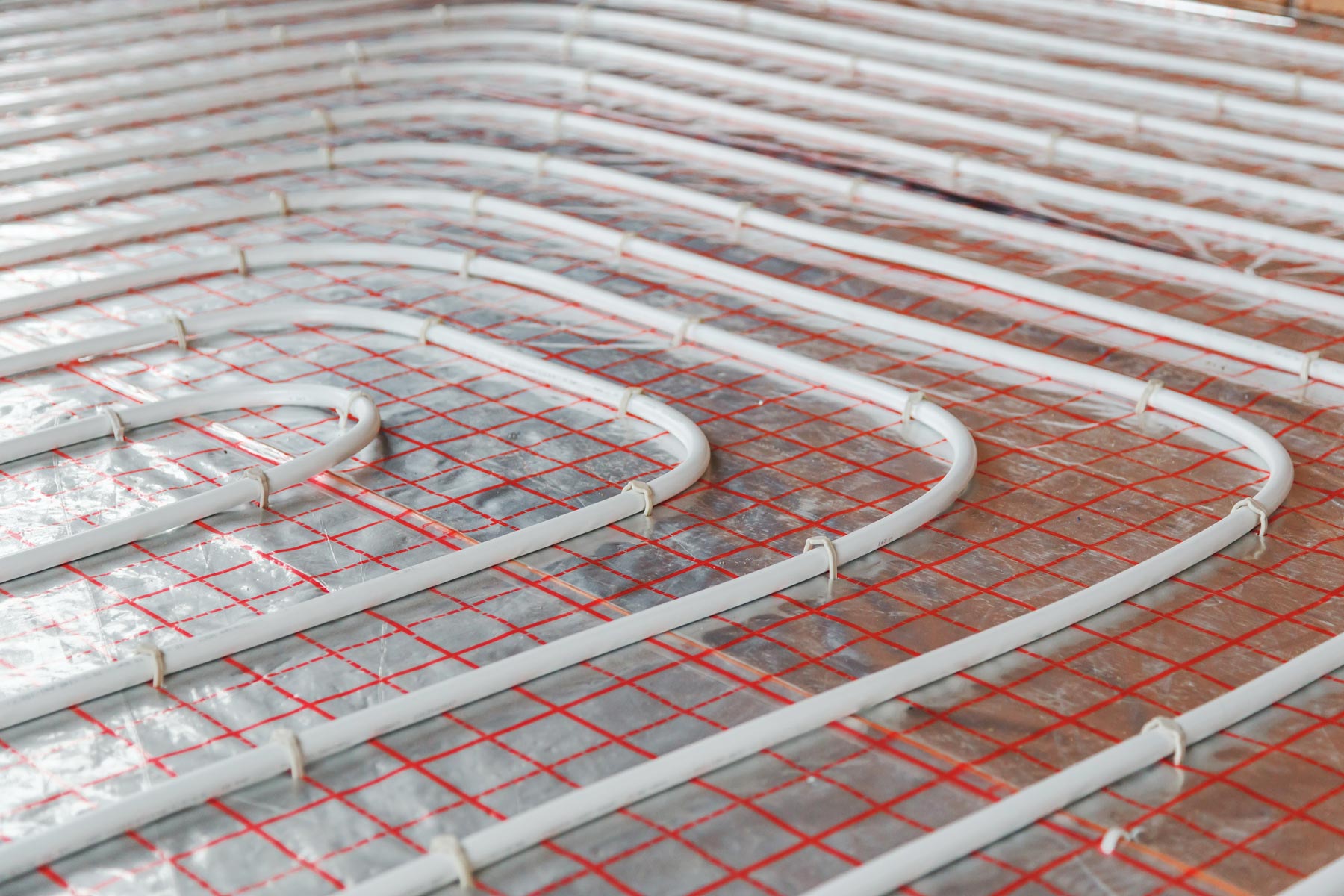
Electric heating mats are pre-spaced resistance cable embedded in a fiberglass mesh backing. The mat is rolled out over the prepared subfloor, embedded in thinset mortar, and tiled over directly. This is the fastest and simplest installation method, which is why it accounts for the majority of residential bathroom heated floor installations in the US. The mat itself requires no special trade license to lay a tile setter handles the floor work. The thermostat wiring, however, requires a licensed electrician in most jurisdictions.
Material cost for a quality electric heating mat runs $10 to $14 per square foot for the mat alone. Top brands include Nuheat, SunTouch, Warmup, and Schluter DITRA-HEAT. Labor to embed the mat and install tile adds $8 to $20 per square foot depending on tile complexity and local contractor rates.
Electric Heating Cables: $5 to $8 per Square Foot Installed
Electric heating cables are individual resistance wire that is custom-routed across the floor surface by the installer. This method offers more layout flexibility than a mat because the cable spacing can be adjusted to work around obstacles like toilet flanges, floor drains, and irregular room shapes. Cable systems cost less per square foot in materials $5 to $8 versus $10 to $14 for mats but the labor time is slightly higher because the cable must be manually laid and secured. For irregular bathrooms, this tradeoff is typically worth it.
Hydronic Radiant Floor Heating: $15 to $30+ per Square Foot Installed
Hydronic systems circulate heated water through cross-linked polyethylene (PEX) tubing embedded in the floor slab or thinset bed. The water is supplied by a boiler or water heater. While hydronic systems have lower long-term operating costs in homes with gas-heated water, the upfront installation cost for a single bathroom is rarely financially justified. The boiler connection, manifold, zone valve, and full tubing layout make it a whole-home infrastructure investment not a single-room upgrade. The comparison table below shows where each system wins and where it falls short.
Recommendation: For 95 percent of homeowners adding heated floors to an existing bathroom, an electric mat or cable system is the correct choice. Hydronic systems make sense only when a whole-home radiant heating installation is already planned. Do not let a contractor upsell you to hydronic for a single bathroom.
Heated Bathroom Floor Material Costs
Material costs in a heated bathroom floor installation include three components: the heating element itself, the thermostat, and any required underlayment or subfloor preparation. Each of these is priced separately in most contractor quotes, and each has meaningful upgrade options that affect both total cost and long-term performance. The table below shows all three components across budget, mid-range, and high-end tiers.
Thermostat: The Upgrade That Pays for Itself
The thermostat is the most underestimated cost and comfort variable in a heated floor installation. Most homeowners focus on the heating element cost and treat the thermostat as an afterthought a mistake that costs more over the system’s life than the upgrade would have. A non-programmable thermostat requires manual switching, which means the floor runs continuously or stays off, both of which increase cost or decrease comfort. A programmable or smart thermostat schedules the floor to heat during morning and evening use periods only, reducing operating costs by 20 to 40 percent. Over a 10-year system life, that savings significantly exceeds the $100 to $200 upgrade cost. The table below compares all three thermostat types.
Labor Cost to Install a Heated Bathroom Floor
Labor is the largest variable in a heated bathroom floor installation, typically representing 50 to 65 percent of the total installed cost. When homeowners look up heated bathroom floor installation cost, they often see wide ranges this is almost entirely due to labor variability, not material differences. Most installations involve two distinct trades: a tile setter or general contractor who embeds the heating element and installs the finish floor, and a licensed electrician who wires the thermostat and connects the circuit to the electrical panel. These two trade costs are often quoted separately and should be included in any accurate budget estimate.
The figures below reflect 2026 national average labor rates. High-cost markets such as New York City, San Francisco, and Boston typically run 30 to 50 percent above these figures.
DIY Guidance: Electric heating mats and cables are DIY-friendly for the floor portion embedding the mat in thinset and tiling over it requires no special license. The thermostat wiring and electrical panel connection, however, requires a licensed electrician in most US states. Attempting unlicensed electrical work creates permit and insurance problems and voids the manufacturer warranty on most systems.
Heated Bathroom Floor Running Cost per Month
Monthly operating cost is one of the most frequently asked questions about heated bathroom floors, and it is also one of the most overstated concerns. The cost to run a heated bathroom floor for a standard 50 to 60 square foot bathroom is $4 to $8 per month when running 2 hours per day at national average electricity rates. Electric floor heating systems draw 12 watts per square foot of heated area on average. At the US national average electricity rate of $0.12 to $0.16 per kWh, even the largest residential primary suites rarely exceed $15 per month in operating cost with scheduled use.
The table below shows estimated monthly and annual operating costs by bathroom size, assuming 2 hours of daily use and the national average electricity rate of $0.14 per kWh. Your actual cost will vary based on local electricity rates and how many hours per day the system runs.
Operating cost formula: (Watts ÷ 1,000) × daily hours × 30 days × electricity rate = monthly cost. Example: 70 sq ft × 12W = 840W. 840W ÷ 1,000 = 0.84 kWh × 2 hrs × 30 × $0.14 = $7.06 per month.
Energy Saving Tip: Adding insulation underlayment beneath the heating mat reduces heat loss downward into the subfloor and can cut operating costs by 20 to 40 percent. At $1 to $3 per square foot installed, insulation board pays for itself in energy savings within 2 to 4 years of daily use.
Best Flooring Materials for Heated Bathroom Floors
Not all flooring materials are compatible with radiant floor heating systems. The best materials conduct and retain heat efficiently, transferring warmth quickly to the surface where you feel it. Poor choices insulate against the heat, wasting electricity and reducing comfort. Tile ceramic, porcelain, or natural stone is the gold standard for heated bathroom floors because it stores and releases heat better than any other residential flooring type. The table below gives a full compatibility overview across all common bathroom flooring materials.
One important note: if you are installing luxury vinyl plank or engineered hardwood over a heated floor system, always verify compatibility directly with the flooring manufacturer before purchase. Using a non-rated product voids the flooring warranty and can cause buckling, warping, or delamination over time.
New Construction vs. Remodel vs. Retrofit Cost
When a heated floor is installed makes a significant difference in the total cost. The best time to install an electric radiant floor heating system is during a tile remodel when the subfloor is already exposed and new tile is being installed regardless. In that scenario, adding a heating mat is an incremental cost of $400 to $700 rather than a full standalone project cost. The worst time, from a cost perspective, is as a standalone retrofit in a bathroom where the existing tile and subfloor are intact and must be disturbed solely for this purpose.
Table below shows how installation timing affects the per-square-foot cost of the same system across four common project contexts.
Hidden and Additional Costs to Budget For
Initial quotes for heated bathroom floor installations frequently exclude several cost items that are either assumed by the contractor, dependent on existing site conditions, or only discovered once work begins. The most common budget surprise is an electrical panel circuit upgrade most heated floor systems draw a dedicated 15- or 20-amp circuit, and many older homes do not have a spare circuit available near the bathroom. Always ask your electrician to confirm panel capacity before finalizing a budget.
Real-World Cost Examples: Three Complete Installations
Generic cost ranges are useful for rough planning, but a line-item budget shows exactly where money is being spent and which components have the most flexibility. The three examples below represent realistic all-in installed costs at budget, mid-range, and high-end specifications, based on 2026 national average pricing. The heating material cost assumes the 70 percent coverage rule applied to each bathroom’s heated area.
Incremental Insight: Notice that the mid-range example is 2.6x the cost of the budget example, not because the system is dramatically better, but because the larger bathroom, higher-quality mat, and tile installation labor scale proportionally. The heating element itself is only $550 more between budget and mid-range the rest is tile and labor.
Are Heated Bathroom Floors Worth the Cost?
For most homeowners, yes and the case is stronger than most people expect before they run the numbers. A $700 to $1,400 investment in a standard bathroom produces a tangible daily improvement that homeowners consistently rate as one of the highest-value upgrades in their home. The floor reaches target temperature within 15 to 30 minutes of activation, dries the floor surface after bathing (reducing mold and moisture accumulation), and delivers a comfort benefit every single day in any climate with a winter season.
From a home value perspective, heated bathroom floors are considered a premium feature in most US real estate markets in the $300,000 to $700,000 price range. They are consistently cited by buyers’ agents as a differentiating feature in competitive listings. The ROI is not as directly measurable as a full bathroom remodel, but the perceived value consistently exceeds the installation cost at resale.
When Heated Floors Are Most Worth It
• In any climate where the bathroom is cold and uncomfortable on winter mornings effectively anywhere with a heating season
• In a master bathroom used daily by the homeowner amortized over years of daily use, the cost per use is very low
• During a bathroom remodel where tile is already being replaced the incremental cost drops to $400 to $700
• In a home being prepared for sale in a market above $350,000, where buyer expectations are higher
When Heated Floors May Not Be Worth It
• In a rental property where ongoing electricity cost falls to the tenant and the comfort benefit accrues to someone other than the owner
• In a guest bathroom used infrequently low daily-use hours reduce the return on the installation cost
• When the existing floor is not being replaced and a full-cost standalone retrofit makes the math work against you
How to Save Money on a Heated Bathroom Floor
The heated bathroom floor installation cost does not have to be a premium expense. Most homeowners overpay on this project by making three avoidable mistakes: installing as a standalone project instead of during a tile remodel, choosing a full mat system when a cable layout would cost less, and skipping the programmable thermostat that would have paid for itself in operating savings within two years. The tips below directly address each of these.
Install during a tile remodel, not as a standalone project. If tile is already being removed and replaced, the incremental cost of adding a heating mat drops to $400 to $700 for most standard bathrooms. This is by far the highest-leverage money-saving decision on this project.
Choose a cable system for irregular layouts instead of a mat. Cables cost $5 to $8 per square foot versus $10 to $14 for mats. In bathrooms with multiple obstacles, cables waste less material and cost less overall.
Add insulation underlayment upfront. It adds $1 to $3 per square foot to the initial cost but reduces monthly operating costs by 20 to 40 percent and pays for itself within 2 to 4 years of daily use.
Invest in a programmable or smart thermostat. A $200 to $350 smart thermostat reduces operating cost by 30 to 40 percent through scheduled operation. Over a 10-year system life, the savings exceed the thermostat upgrade cost.
Handle tile work yourself if experienced. Embedding the mat in thinset and setting tile over it is within the skill range of a confident DIYer. This saves $400 to $800 in tile installation labor. The electrical thermostat wiring must still be done by a licensed electrician.
Get three written, itemized quotes. Installation rates for heated floors vary 30 to 50 percent between licensed contractors in the same metro area. Always compare itemized quotes not single-line estimates to see exactly what is and is not included.
Key Takeaway
The average heated bathroom floor cost is $700 to $1,400 installed for a standard 50-square-foot bathroom using an electric heating mat system with a programmable thermostat. Material costs run $5 to $20 per square foot depending on system type. Labor adds $4 to $10 per square foot. Monthly operating costs are $5 to $15 for most residential bathrooms. Hydronic (water) systems cost significantly more $2,000 to $6,000 for a single bathroom and are only recommended for whole-home new construction installs.
Frequently Asked Questions
How much does a heated bathroom floor cost?
The average heated bathroom floor cost is $700 to $1,400 for a 50-square-foot bathroom using an electric heating mat system, professionally installed with a programmable thermostat. Per square foot, installed cost runs $8 to $25 depending on system type and flooring material. Hydronic systems cost $2,000 to $6,000 for the same bathroom.
How much do heated bathroom floors cost to install?
The cost to install a heated bathroom floor is $500 to $2,000 for most standard residential bathrooms using electric radiant systems. Material costs run $5 to $20 per square foot. Labor adds $4 to $10 per square foot. Electrician fees for thermostat wiring add $100 to $260. Total installed cost for a 50-square-foot bathroom typically runs $700 to $1,200 at mid-range specifications.
How much does it cost to install heated bathroom floors?
For a standard 60 to 80 square foot primary bathroom, the complete installed cost for an electric heated floor system including heating mat, programmable thermostat, tile installation, and electrician runs $900 to $2,200. New construction installations cost 20 to 40 percent less than retrofit installs because tile demo is not required.
How much does radiant floor heating cost for a bathroom?
Electric radiant floor heating for a bathroom costs $700 to $2,000 installed, depending on system type, bathroom size, and flooring material. Hydronic radiant floor heating for a single bathroom costs $2,000 to $6,000. Electric systems are the correct choice for virtually all single-room bathroom applications.
What is the cost of a heated bathroom floor per square foot?
Heated bathroom floor cost per square foot is $8 to $25 installed, all-in. Electric heating mat systems run $14 to $22 per square foot installed including tile. Electric cable systems run $10 to $18 per square foot installed. These figures include the heating element, thermostat (prorated), labor for embedding and tiling, and electrician fees.
How much does it cost to run a heated bathroom floor?
The cost to run heated bathroom floor systems is $5 to $15 per month for most standard bathrooms, based on 2 hours of daily use at national average electricity rates of $0.12 to $0.16 per kWh. Annual operating cost is typically $50 to $120. Adding a programmable or smart thermostat reduces this by 20 to 40 percent through scheduled operation.
How much does a heated tile bathroom floor cost?
A heated tile bathroom floor the most common installation type costs $10 to $22 per square foot installed. This includes the heating mat or cable embedded in thinset, a programmable thermostat, and the tile floor installation on top. For a standard 60-square-foot bathroom with 42 square feet of heated area, total cost is $900 to $1,800 all-in.
Are heated bathroom floors worth the cost?
Yes, for most homeowners, heated bathroom floors are worth the cost. The installation cost of $700 to $1,400 for a standard bath delivers daily comfort at an operating cost of $5 to $15 per month. The system also dries the floor after bathing, reducing mold growth and improving hygiene. The best time to install is during a tile remodel when the incremental cost drops to $400 to $700.
What is the cost to add heated floors to a bathroom during a remodel?
Adding heated floors during a tile remodel costs $400 to $900 in incremental cost above the standard tile work, because the tile is already being removed and reinstalled. The heating mat itself costs $350 to $600 for a standard bath. Electrician fees for thermostat wiring add $100 to $200. The tile installation cost remains unchanged because the mat is embedded in the same thinset layer that the tile installer was already using.
What is the cost of installing a heated bathroom floor?
The cost of installing a heated bathroom floor ranges from $500 to $2,000 for a standard residential bathroom using an electric radiant system. The cost of installing heated bathroom floor and the cost of heated bathroom floor projects more broadly varies based on three main factors: whether the tile is already being replaced (reduces cost by 30 to 40 percent), the heating system type chosen (mat versus cable), and local labor rates.
For a 60-square-foot bathroom, total installed cost including materials, tile work, and electrician typically runs $900 to $1,500. Heated bathroom flooring cost in this range reflects electric systems only; hydronic systems run significantly higher.
What is the radiant floor heating bathroom cost?
The radiant floor heating bathroom cost depends on whether you choose an electric or hydronic system. Electric radiant floor heating bathroom cost runs $700 to $2,000 installed for most standard bathrooms. Hydronic radiant heat bathroom floor cost is significantly higher at $2,000 to $6,000 for a single bathroom because it requires boiler connections, PEX tubing, a manifold, and zone valves. In floor heating bathroom cost for hydronic systems only makes sense across a whole-home installation. For a single bathroom, electric is the correct choice in almost all cases.
What is the cost per square foot for a heated bathroom floor?
The cost per square foot heated bathroom floor is $8 to $25 installed, all-in, for electric radiant systems. Electric mat systems cost $14 to $22 per square foot installed including tile. Cable systems run $10 to $18 per square foot installed. Hydronic systems run $25 to $40+ per square foot for a single bathroom. Always calculate cost based on heated area typically 70 percent of total square footage not total bathroom size, as areas under fixed cabinetry and the toilet are not heated. The heated bathroom tile floor cost per square foot is $14 to $22 for tile-over-mat installations, which is the most common setup.
What does it cost to add heated floors to a bathroom?
The cost to add heated floors to bathroom projects depends heavily on timing. Adding heated floors during a tile remodel costs $400 to $900 incremental above the tile work. Adding heated floors as a standalone project where existing tile must be removed first costs $800 to $2,500 all-in for a standard 60 to 80 square foot bathroom. As a retrofit under existing LVP flooring without tile demo, the cost runs $600 to $1,200 using thin-profile mat systems compatible with floating floor installation.