
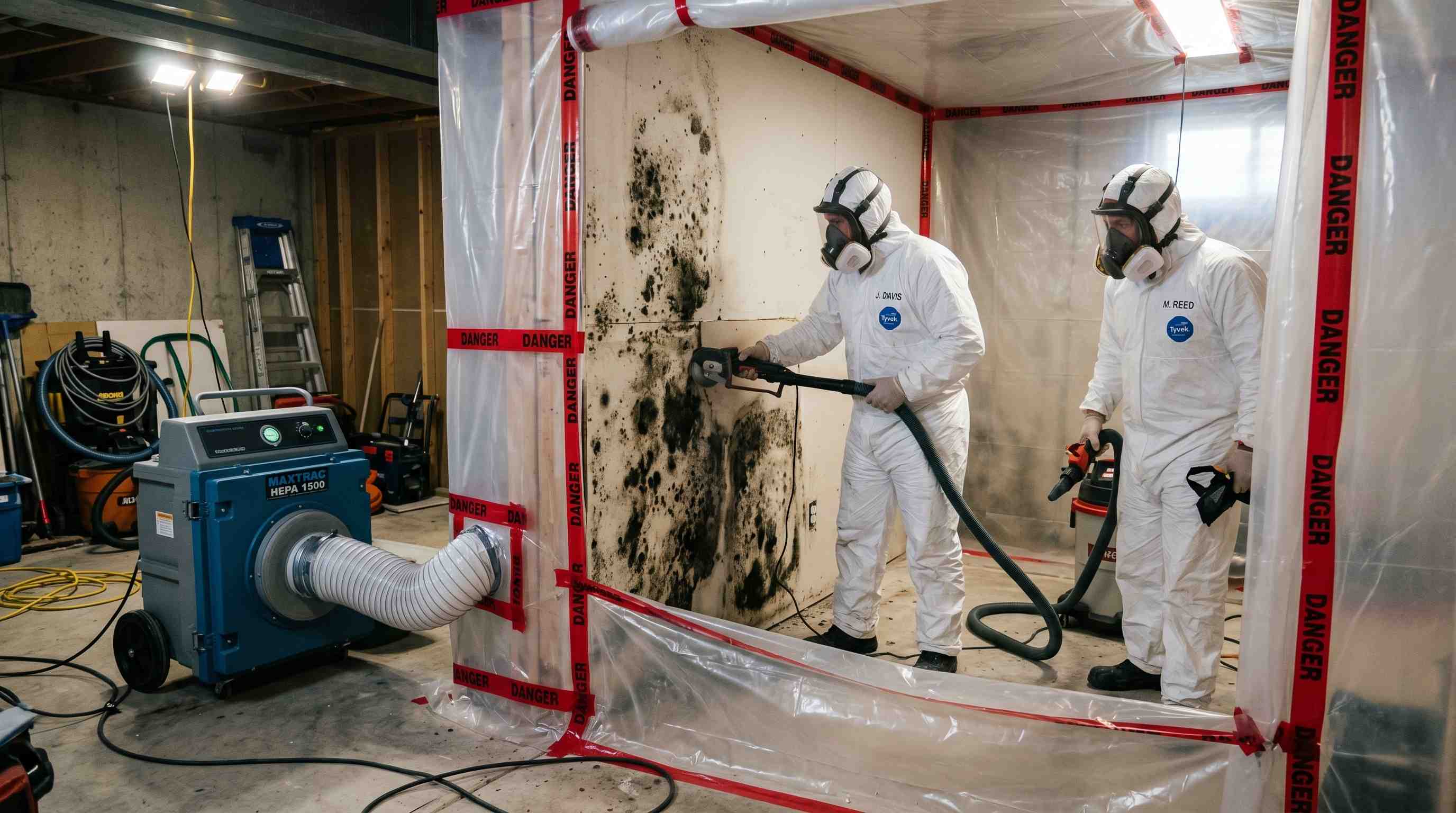

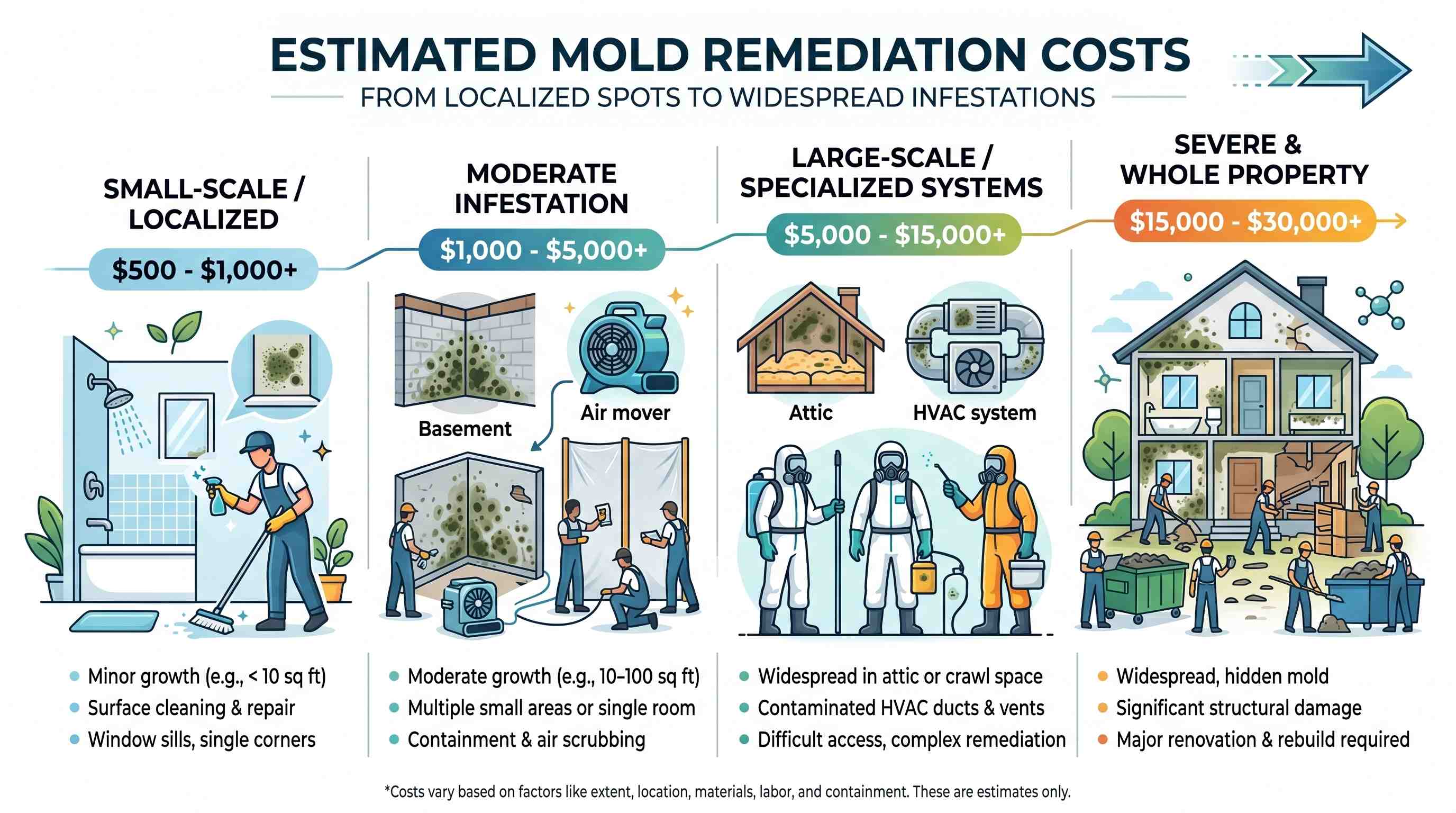
The national average mold remediation cost in 2026 is $2,368, with most homeowners paying between $1,200 and $3,750 for professional mold removal. But the actual range spans $500 for a small bathroom spot to $30,000 or more for a whole-house mold infestation, a 60-times gap that comes down almost entirely to how much area is affected and where in the home the mold is growing.
This guide gives you real numbers by location, explains the factors that drive costs higher, covers what insurance actually pays (and what it doesn't), and tells you when DIY is safe and when it's a mistake.
Quick-Reference Cost Table
Mold Remediation Cost by Location
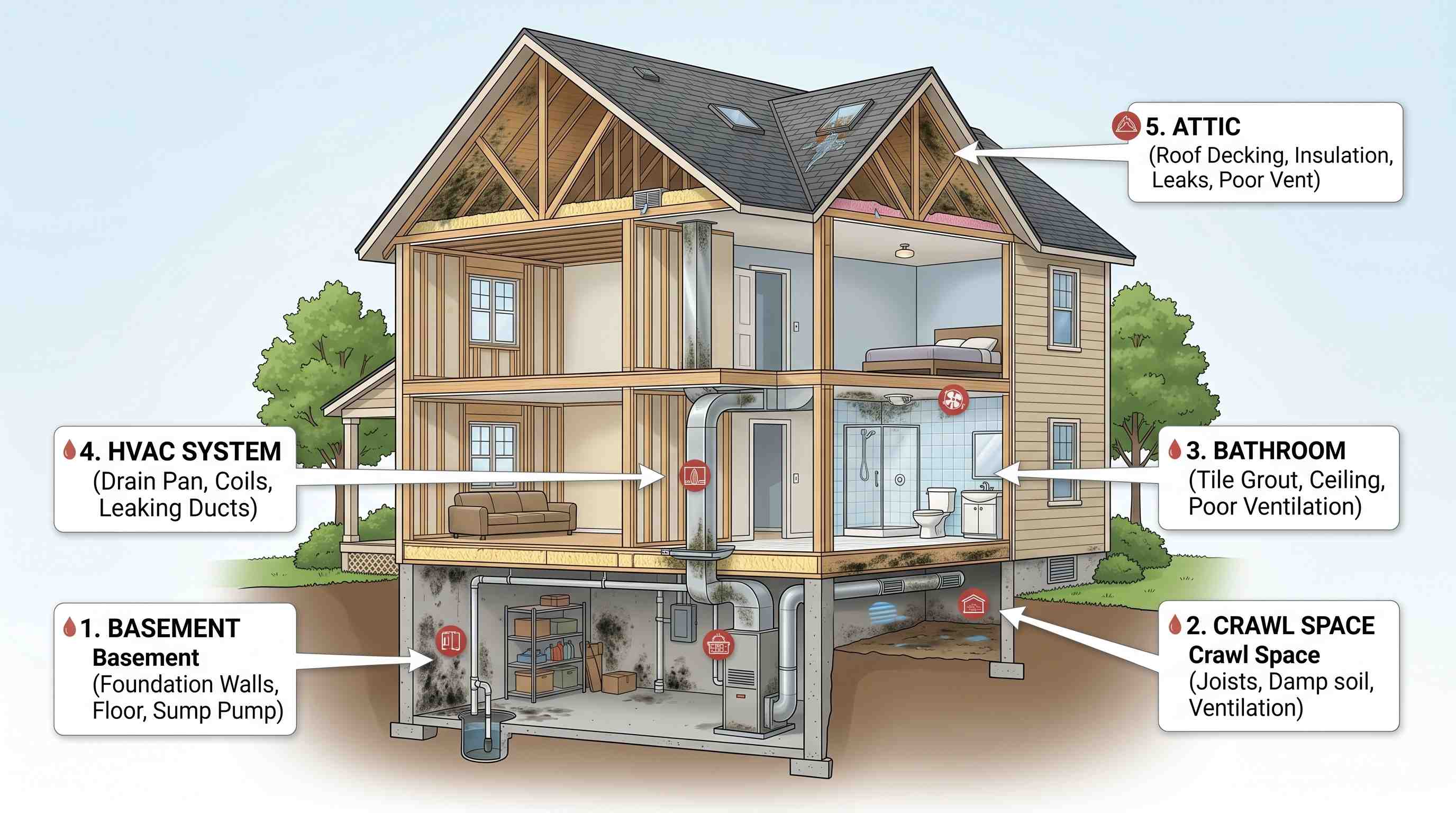
Location is the single biggest driver of your final bill not because of local labour rates, but because of how difficult and how widespread the mold is.
Bathroom Mold Removal Cost: $500–$2,000
Bathrooms are where most homeowners first discover mold, and they're also the least expensive location to remediate. The mold removal cost in a bathroom typically runs $500 to $2,000 depending on whether growth is on the tile surface (cheapest) or has penetrated behind drywall or under flooring (most expensive).
Visible surface mold on tile grout or caulk is straightforward containment, treatment, and cleaning is a one-day job. If the mold reaches the drywall or subfloor from a leaking pipe or failed caulk joint, the cost increases because contaminated materials must be removed and replaced. Bathroom mold removal cost rises to $3,000–$8,000 when structural materials are affected.
The cause matters for insurance: bathroom mold from a sudden burst pipe may be covered; mold from months of failed grout and accumulated humidity almost never is.
Basement Mold Remediation Cost: $500–$3,000
Basements account for a large share of residential mold calls because they combine moisture, limited airflow, and organic building materials. Surface basement mold costs $500 to $3,000. Mold behind finished walls or panelling which requires opening the wall to reach the contamination pushes costs to $5,000–$15,000.
After remediation, address the underlying cause. A basement mold job without a waterproofing fix typically sees mold return within 12–24 months. Basement waterproofing costs $6,000–$18,000; a dehumidifier installation costs $1,100–$2,800. These are additional costs on top of remediation.
Attic Mold Remediation Cost: $1,000–$4,000
Attic mold is often discovered only after significant spread, because attics aren't checked regularly. Accessible attic mold with limited spread costs $1,000–$4,000. If mold has penetrated insulation, rafter boards, or roof decking, costs climb to $7,000–$15,000, and the damaged insulation needs replacing (separate cost).
The most common cause is a roof leak or inadequate ventilation. Fix the ventilation before remediation begins without this, mold returns.
Crawl Space Mold Remediation Cost: $500–$2,000
Crawl spaces are dark, damp, and often go years without inspection. The good news is they're typically small. Mold removal in a crawl space costs $500–$2,000 for most jobs. Adding a vapor barrier (crawl space encapsulation) costs $1,500–$15,000 depending on size but dramatically reduces recurrence.
HVAC Mold Remediation Cost: $3,000–$10,000
HVAC systems are the most expensive mold location because an active system distributes spores through every duct in the house. The moment you suspect mold in the HVAC, shut it off. Remediation costs $3,000–$10,000 depending on how far the contamination has spread through the duct network. Never ignore HVAC mold a system running with mold inside it can turn a localised contamination into a whole-house mold infestation within weeks.
Whole-House Mold Infestation: $10,000–$30,000+
A whole-house mold infestation typically results from prolonged moisture, a slow roof leak, a long-term plumbing failure, or severe flooding. The IICRC reports that approximately 30% of residential mold projects involve this level of contamination. Cost ranges from $10,000 to $30,000 or more, including demolition, containment, HEPA filtration throughout the home, antimicrobial treatment, and post-remediation clearance testing. Reconstruction after removal (new drywall, insulation, flooring) adds another 30–50% on top of the remediation bill.
Black Mold Remediation Cost: $2,000–$6,000
Black mold (Stachybotrys chartarum) commands a 25–50% premium over standard mold remediation. The higher cost pays for full-face respirators, negative-pressure containment rooms, continuous HEPA air scrubbing during all demolition, and mandatory third-party clearance testing before the job can be signed off.
Important: Visual identification cannot confirm Stachybotrys. Dark-coloured mold requires lab testing to identify the species. Your remediator should name the species in writing on any black mold bid. If they tell you it's definitely black mold before lab results, treat that as a red flag.
Typical 50–200 sq ft black mold jobs land at $2,500–$6,000. Large infestations or those requiring extensive structural removal can exceed $10,000.
Mold Remediation Cost Per Square Foot
Most contractors price mold work on square footage with modifiers stacked on top.
Regional swing: Labour rates in the Northeast and coastal California run 15–25% above the national average. Southern and Gulf Coast markets tend to have more competitive pricing due to higher contractor supply.
Emergency premium: Same-day or after-hours remediation adds 20–40% to standard pricing.
Does Insurance Cover Mold Remediation?
This is where most homeowners get a shock. The coverage rule is binary and non-negotiable:
Insurance covers mold only when it results from a "sudden and accidental" covered peril. A burst pipe. An appliance overflowed. A storm event. In those cases, the mold is a consequence of the covered water damage, and many policies will cover remediation up to the mold sub-limit.
Insurance does NOT cover mold from: gradual leaks, condensation, poor ventilation, deferred maintenance, humidity-driven growth, or flooding (unless you have separate flood insurance). Most residential mold occurs from exactly these excluded causes.
The sub-limit trap: Even when coverage applies, most homeowners insurance policies cap mold remediation at $1,000–$10,000, regardless of actual cost. A $15,000 attic remediation job may only see $5,000 covered. Always check the mold endorsement or rider on your specific policy.
The correct insurance filing sequence
This is the step no competitor article clearly explains:
Document everything before any cleanup photograph the mold and all visible water damage with timestamps
File the water damage claim first the mold claim rides on the water damage claim; if the water event is covered, the mold often follows
Contact your insurer before calling a remediation company some policies require pre-authorisation
Ask specifically about Additional Living Expenses (ALE) if the mold is severe enough that you can't safely stay home, temporary housing may be covered separately
DIY vs Professional Mold Removal
The EPA and CDC draw the line at 10 square feet on non-porous surfaces. Below that threshold, a healthy adult with protective gear can handle the job.
DIY mold removal supplies: $50–$300
N95 respirator (minimum; full-face respirator for black mold)
Disposable gloves and eye protection
Plastic sheeting to seal the area
Commercial mold remover or enzyme cleaner
The bleach myth: Bleach removes the stain but does not kill mold on porous surfaces like drywall, wood, or grout. It penetrates the surface colour but not the root structure. Using bleach gives a false sense of completion while mold continues to grow inside the material. For non-porous surfaces only (tile, glass, sealed concrete), bleach can be effective.
When to hire a professional no exceptions:
More than 10 square feet of affected area
Mold inside walls, insulation, or HVAC systems
Anyone in the household has asthma, respiratory conditions, or a compromised immune system
Previous DIY attempts that didn't resolve the problem
Visible mold with a musty smell that returns within weeks of cleaning
Professional mold remediation: $1,500–$30,000+ depending on scope. Professional remediation follows the IICRC S520 standard, includes containment barriers, HEPA filtration, antimicrobial treatment, and post-remediation clearance testing. They also carry insurance if something goes wrong during the process, you're protected.
What Drives Mold Remediation Costs Higher
Beyond size and location, five factors can significantly escalate your bill:
1. Hidden mold behind walls. When visible mold is a symptom of a much larger hidden problem, costs escalate fast. A surface patch that looks like $1,500 of work can open into $10,000 once walls come down.
2. Structural damage. Mold that has weakened framing, subflooring, or load-bearing members requires a licensed contractor for structural repair a separate cost from remediation.
3. Asbestos in older homes. Pre-1980 homes may require asbestos testing before any demolition. If asbestos is present, both remediation processes must be sequenced asbestos abatement first, mold remediation second. Budget for both.
4. Emergency/after-hours response. Add 20–40% for same-day or weekend work.
5. Post-remediation reconstruction. Remediation removes the mold and contaminated materials. It does not replace them. Budget separately for drywall replacement ($300–$850), flooring, insulation, and paint typically 30–50% on top of the remediation cost.
How to Hire a Mold Remediation Company
Verify IICRC AMRT certification the industry standard credential is "Applied Microbial Remediation Technician." Ask to see the certificate before signing anything.
Get at least three written bids. Include the same scope (containment, removal, clearance testing) in every bid. A bid that's substantially lower than all others probably excludes post-remediation testing or skips containment.
Never hire the same company for inspection AND remediation. A company that inspects your home and then quotes you for remediation has a financial incentive to find more mold. Use an independent inspector for the assessment. Then hire a separate company for remediation.
Red flags to walk away from:
"Your family is in immediate danger we need to start today" (pressure tactic)
Requiring full payment before work begins (legitimate contractors cap deposits at 10–25%)
Offering a "free mold inspection" door-to-door after a local weather event
Unable to name the mold species without lab testing
No IICRC certification on request
The Rule That Makes Remediation Permanent
Every mold remediation company will tell you this, but it doesn't get enough emphasis: mold cannot grow without moisture. Fix the moisture source before remediation begins not after.
A basement mold job without a waterproofing fix returns within 12–24 months. An attic remediation without correcting the roof ventilation fails by the next wet season. The remediation warranty if the contractor offers one is typically voided if the water source wasn't corrected and mold recurs.The most cost-effective thing you can do after discovering mold is identify and fix what caused it before getting your first remediation bid.
Frequently Asked Questions
How much does mold remediation cost for an average home?
The national average mold remediation cost in 2026 is $2,368, with most projects ranging from $1,200 to $3,750 according to Angi data. The actual cost depends heavily on location in the home and the size of the affected area. Bathroom and crawl space jobs sit at the lower end; HVAC and whole-house infestations sit at the top.
What is the average cost to remove mold from a basement?
Basement mold removal costs $500–$3,000 for accessible surface mold. Jobs requiring wall demolition to reach hidden mold run $5,000–$15,000. The total depends on whether the mold is on the surface or has penetrated into building materials.
What is the bathroom mold removal cost?
Bathroom mold removal cost runs $500–$2,000 for most jobs. Surface mold on tile or caulk is the cheapest and quickest to remediate. Costs increase significantly if the mold has reached drywall, subfloor, or structural materials behind fixtures expect $3,000–$8,000 for those scenarios.
How long does mold remediation take?
Most residential mold remediation projects take 1–5 days. A single bathroom wall can be completed in one day. Larger projects involving multiple rooms, HVAC systems, or structural demolition may take one to two weeks including reconstruction.
Does homeowners insurance cover mold removal?
Only when mold results from a "sudden and accidental" covered event like a burst pipe or appliance overflow. Mold from gradual leaks, humidity, or poor ventilation is excluded. When coverage does apply, most policies cap mold remediation at $1,000–$10,000. File the water damage claim first the mold claim depends on it.
Can mold come back after professional remediation?
Yes, if the moisture source isn't corrected. Mold remediation removes existing growth but cannot prevent new growth if the conditions that caused it remain. Professional remediation paired with fixing the underlying water or humidity problem is the only combination that produces a permanent result.
What is the cheapest way to remove mold?
For areas under 10 sq ft on non-porous surfaces (tile, glass, sealed concrete), DIY with protective gear and an enzyme cleaner costs $50–$300. For anything larger or on porous materials, professional remediation is the cheapest option in the long run failed DIY that spreads spores can turn a $2,000 job into a $10,000 one.